Table of Contents
Last updated: 15 September 2026 | Reviewed by Mathibharathi Mariselvan, Co-founder, Pixel Web Solutions | 13 min read
Flash loan arbitrage bot development means building a smart contract and an off-chain scanner that borrow funds with no collateral, buy a token where it is cheap, sell it where it is dear and repay the loan in one atomic transaction. If the trade does not cover the loan fee, the whole transaction reverts and only the gas is lost. A single-chain bot typically costs $6,000 to $15,000 to build, and a multi-chain bot with MEV protection and a dashboard $15,000 to $40,000.
In the fast-paced world of DeFi, flash loan arbitrage remains one of the most capital-efficient trading strategies available. You can borrow millions without collateral, execute trades across several liquidity pools and keep the difference, all within a single block.
Here is the catch, though. Price gaps between DEXs close in milliseconds, and in 2026 you compete with professional MEV searchers who run the same playbook. Manual trading cannot keep up, and a badly built bot pays gas on every failed attempt. This guide explains how flash loan arbitrage bots work, which providers and chains to use, what a bot costs to build, where profit still exists and how to avoid the scam bots that flood YouTube.
Key Takeaways
- A flash loan is borrowed and repaid in the same transaction. If repayment fails, every step reverses, so the lender never loses funds. You still pay gas for the failed attempt.
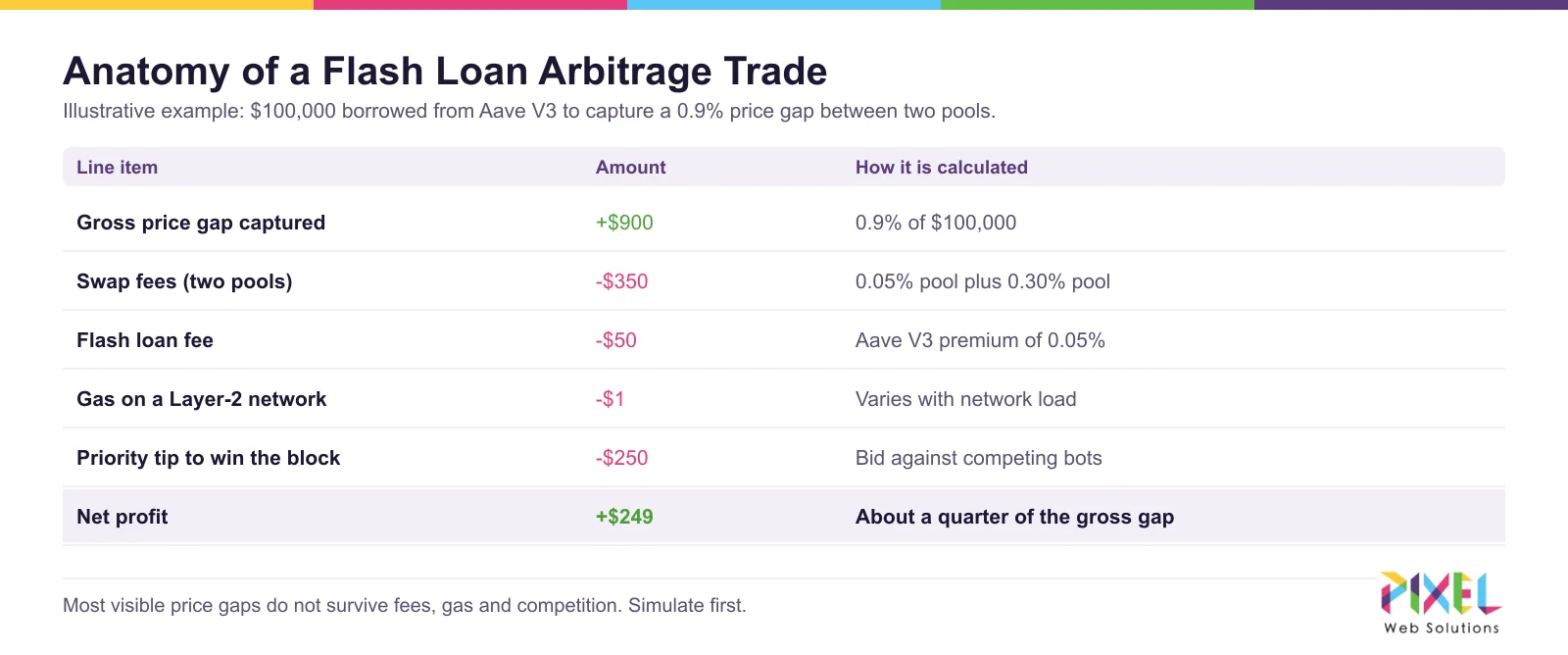
- Profit is the price gap minus swap fees, the flash loan fee, gas and the tip needed to win the block. Most visible gaps do not survive that arithmetic.
- Aave V3 charges 0.05% per flash loan, Uniswap charges its pool fee, and Morpho charges nothing. Balancer V2, once the favourite zero-fee source, is winding down its pools in 2026.
- Custom development costs $6,000 to $80,000+ depending on chains, strategies, MEV protection and whether you need a multi-user platform.
- "Free" flash loan bots shared on YouTube are usually wallet drainers. SentinelLABS traced more than $900,000 stolen through fake bot contracts.
Flash Loan Arbitrage Bot Development – An Overview
Flash loan arbitrage bot development refers to the process of building an automated system that profits from price differences of the same token across decentralized exchanges (DEXs). The bot borrows the trade capital through a flash loan, so the operator needs no inventory, only enough native tokens for gas.
A working bot has two halves. The on-chain half is a smart contract that requests the flash loan, executes the swaps and repays the lender, reverting if the numbers do not add up. The off-chain half is a scanner that watches pool prices, simulates each candidate trade and submits only the ones that clear a profit threshold. Development therefore combines Solidity or Rust, low-latency infrastructure and a solid grasp of blockchain programming languages and DeFi protocol mechanics.
Understanding the overview naturally raises the next question: what actually happens inside one of these transactions?
How does the Flash Loan Arbitrage Bot work?
A crypto flash loan arbitrage bot runs the same five-step loop for every opportunity it finds, and the whole loop fits inside one blockchain transaction.
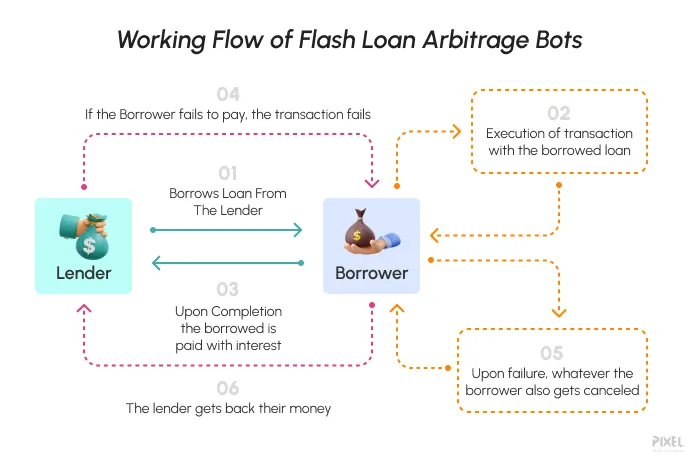
- Detect. The scanner spots that a token trades lower on one pool (say Uniswap) than on another (say SushiSwap or Curve) and simulates the full trade, including fees and gas.
- Borrow. The bot's contract requests a flash loan from a lending protocol such as Aave. No collateral is needed because the loan must come back in the same transaction.
- Buy low. The contract swaps the borrowed funds into the token on the cheaper pool.
- Sell high. It then sells the token on the pricier pool, ending with more of the borrowed asset than it started with.
- Repay and keep the rest. The contract repays the loan plus the fee. Whatever remains is profit, sent to the owner's wallet.
If step 5 cannot complete, the lending protocol reverts the entire transaction. Every swap unwinds as if it never happened. This is why flash loans are safe for lenders, but it is not "risk-free" for the bot operator: the failed transaction still consumes gas, and a bot that fires often on bad simulations can bleed money.
What the smart contract looks like
For developers searching for a flash loan arbitrage smart contract, here is the skeleton of an Aave V3 receiver. It shows the structure every production bot builds on: an owner-only trigger, a callback that checks who called it, the swap route and a hard profit check that reverts the trade if it loses money.
// Illustrative skeleton only. Not audited, not production code.
contract FlashArb is FlashLoanSimpleReceiverBase {
    address public immutable owner;

    constructor(IPoolAddressesProvider provider) FlashLoanSimpleReceiverBase(provider) {
        owner = msg.sender;
    }

    function start(address asset, uint256 amount, bytes calldata route) external {
        require(msg.sender == owner, "not owner");
        POOL.flashLoanSimple(address(this), asset, amount, route, 0);
    }

    function executeOperation(address asset, uint256 amount, uint256 premium,
        address initiator, bytes calldata route) external override returns (bool)
    {
        require(msg.sender == address(POOL) && initiator == address(this), "untrusted");
        _swapRoute(asset, amount, route);          // buy low on DEX A, sell high on DEX B
        uint256 owed = amount + premium;
        require(IERC20(asset).balanceOf(address(this)) >= owed, "not profitable");
        IERC20(asset).approve(address(POOL), owed);
        return true;
    }
}
The two require checks in executeOperation matter most. Without the caller check, anyone could trigger your contract with a malicious route. Without the profit check, a bad trade would drain the gas budget with nothing to show for it.
Types of Flash Loan Arbitrage Strategies
Not every flash loan bot hunts the same opportunity. The strategy decides the code, the chains and the competition you face.
- DEX-to-DEX arbitrage. The classic two-pool trade: buy on one exchange, sell on another. Simple to build, but the most crowded strategy on Ethereum mainnet.
- Triangular arbitrage. Three swaps across three pairs (for example USDC to ETH to WBTC to USDC) on one or more DEXs, profiting when the cross rates drift apart.
- Stablecoin and pegged-asset arbitrage. Trades between stablecoin pools or liquid staking tokens when a peg wobbles. Margins are small per trade but opportunities appear during market stress.
- Liquidation arbitrage. The bot borrows to repay an undercollateralized loan on a lending protocol, receives the collateral at a discount and sells it. This remains one of the more reliable flash loan strategies because protocols pay a bonus for the service.
- Collateral swaps and refinancing. Not arbitrage in the strict sense, but the same machinery lets users move debt between protocols or swap collateral without closing positions, which some platforms offer as a paid service.
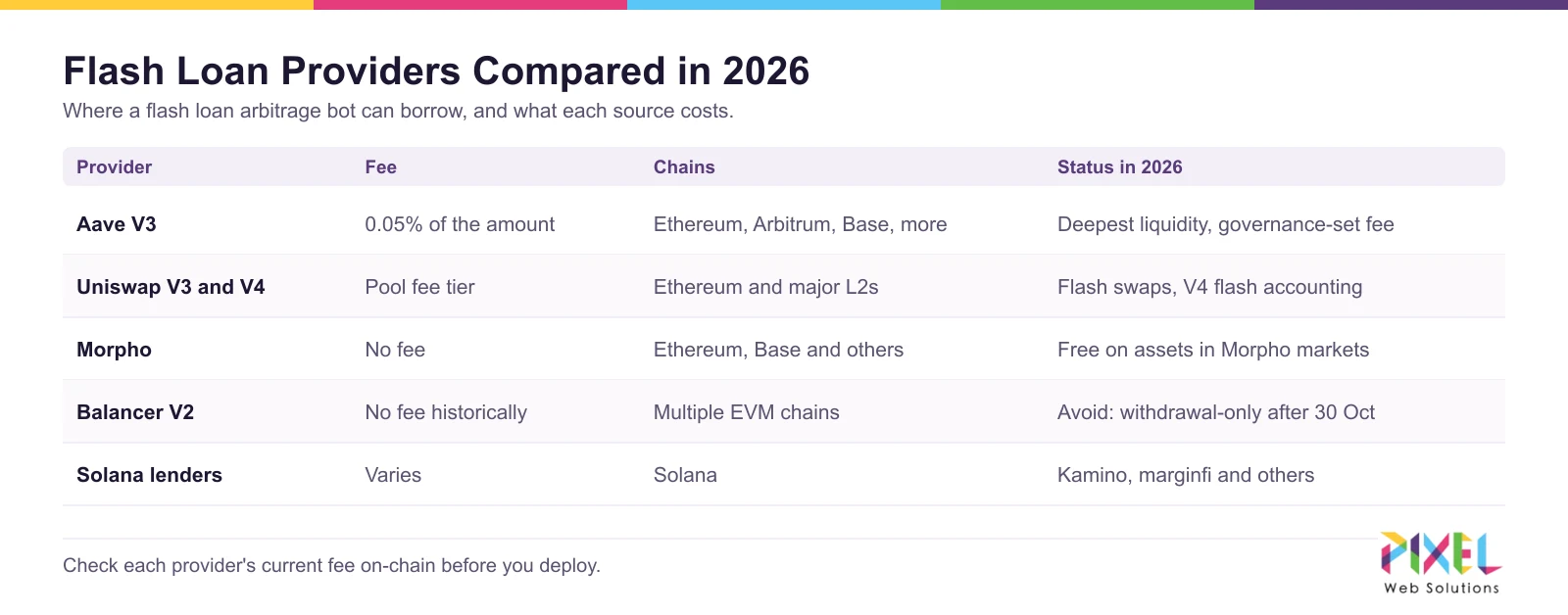
Flash Loan Providers Compared
The provider you borrow from sets your fee, your available liquidity and the chains you can run on.
| Provider | Flash loan fee | Chains | Notes for 2026 |
|---|---|---|---|
| Aave V3 | 0.05% of the amount | Ethereum, Arbitrum, Base, Polygon, Optimism, Avalanche and more | Deepest liquidity. Fee is set by governance, so read FLASHLOAN_PREMIUM_TOTAL before you deploy |
| Uniswap V3 and V4 | The pool's fee tier (0.01% to 1%) | Ethereum and most major L2s | Flash swaps let you receive tokens before paying for them. V4 uses flash accounting inside its single contract |
| Morpho | No fee | Ethereum, Base and other EVM chains | Free flash loans on assets held in Morpho markets |
| Balancer V2 | No fee historically | Multiple EVM chains | Avoid for new builds. After the November 2025 exploit, pools move to withdrawal-only after 30 October 2026 |
| Solana lending protocols | Varies by protocol | Solana | Protocols such as Kamino and marginfi support flash loans inside a single Solana transaction |
Fees and terms come from each provider's protocol documentation.
Having explored how the bot works and where it borrows, it is time to see why building your own beats renting one.
Why do you need to develop your own Flash Loan Arbitrage Bots?
While there are many advantages, these three matter most.
Potential Profits
A flash loan bot scans many pools at once and acts in the same block, which no human can match. The faster and more accurate the bot's simulation, the more of the available opportunities it captures instead of losing them to competing searchers. Profit is never guaranteed, however, so the goal is a bot that only fires when the numbers work.
Complete Customization
A custom build lets you choose your chains, pools, strategies and risk limits. Off-the-shelf bots run the same logic as every other copy, so they compete for the same trades. Your own strategy, your own routes and your own profit thresholds are the only real edge in arbitrage.
Competitive Advantage and Control
Owning the code means you control the private keys, the contract and the profits. Third-party "bot as a service" platforms often take a share of profit and can see your strategy. With your own bot, execution speed, gas bidding and MEV protection are all tuned to your goals.
With the "why" in place, let us look at the features that separate a profitable bot from an expensive experiment.
Essential Features We Include in Our Flash Loan Arbitrage Bot Development
These features keep a flash loan arbitrage bot efficient, profitable and safe.
- Flash loan integration. Connections to Aave V3, Uniswap flash swaps, Morpho or chain-specific lenders, with automatic selection of the cheapest source for each trade.
- Multi-DEX and multi-chain support. Price feeds and routing across Uniswap, SushiSwap, Curve, PancakeSwap and chain-native DEXs, so the bot sees more opportunities.
- Pre-trade simulation. Every candidate trade is simulated against the latest state before submission. This single feature saves more money than any other, because it stops the bot from paying gas on trades that would revert.
- Profit threshold and gas model. The bot calculates net profit after swap fees, the flash loan fee, gas and the priority tip, and only fires above your minimum.
- MEV protection. Private transaction submission through Flashbots Protect or builder bundles, so other bots cannot see and front-run your trade in the public mempool.
- Automated loan repayment and rollback. The contract repays in the same transaction and reverts cleanly if anything fails.
- Smart contract security. Owner-only functions, caller verification in callbacks, no stored balances and withdrawal controls.
- Real-time data access. Low-latency RPC nodes or your own node, websocket price streams and on-chain event listeners.
- Admin dashboard. Live profit and loss, failed-trade logs, gas spend, strategy settings and a kill switch.
- Multi-user and white-label options. For platforms that sell bot access to customers: user accounts, per-user wallets or contracts, subscription billing and an admin panel.
While many features can improve a flash loan bot, these form the base of a reliable one. Now let us walk through how we build it.
How to develop a Crypto Flash Loan Arbitrage Bot?
Our custom flash loan arbitrage bot development process is built to deliver high-performance, secure and measurable DeFi trading bots. Here is how we do it.
1. Discovery and Strategy Planning
Every project starts with your goals and constraints. In this phase, we:
- Identify your target chains (Ethereum, Arbitrum, Base, BNB Chain, Polygon, Solana)
- Choose the strategy: DEX-to-DEX, triangular, liquidation or a mix
- Select flash loan providers by fee and liquidity on each chain
- Map the DEXs and trading pairs with enough depth to matter
2. Bot Architecture Design
With the strategy locked in, we design:
- The transaction flow for borrowing, swapping and repaying in one transaction
- Pricing logic, trade triggers and fallback routes
- The submission path: public mempool, private RPC or bundles
3. Smart Contract Development and Backend Integration
This is where the logic becomes code. Our team handles the smart contract development and connects it to a fast backend:
- Solidity (or Rust on Solana) contracts for flash loan and swap execution
- Real-time monitoring with ethers.js, viem or web3.py
- Backend services that detect, simulate and submit trades automatically
4. Simulation and Stress Testing
Before mainnet, we test against reality:
- Replay historical blocks and fork mainnet to test real opportunities
- Measure execution time, gas cost and slippage per route
- Stress-test during congestion and volatile market conditions
5. Deployment and Post-Launch Monitoring
Once tested, we launch on your chosen chains:
- Contract deployment and configuration
- Live integration with DEXs, lenders and private submission endpoints
- Dashboards, alerts and a kill switch
After launch, we keep tuning routes, gas bidding and thresholds, because arbitrage conditions change every week.
Tech Stack We Use in Our Flash Loan Arbitrage Bot Development
A flash loan bot needs millisecond-level execution across several protocols, so the stack matters as much as the strategy.
Supported Blockchain Networks
- Ethereum: the deepest liquidity and the fiercest MEV competition.
- Arbitrum and Base: low-cost Layer-2 networks with growing DEX volume and fewer competing searchers on long-tail pairs.
- BNB Chain: PancakeSwap liquidity and low fees.
- Polygon (POL): low gas and many small pools. Polygon renamed its token from MATIC to POL in 2024.
- Solana: very low fees and fast blocks, with flash loans available from native lending protocols.
DeFi Protocols and Liquidity Sources
- Aave V3 and Morpho for flash loans.
- Uniswap, SushiSwap, Curve and PancakeSwap for swaps and cross-DEX pricing.
- Chain-specific DEXs such as Aerodrome on Base and Raydium or Orca on Solana.
Development Frameworks and Tools
- Languages: Solidity, Rust, TypeScript, Python
- Libraries: ethers.js, viem, web3.py
- Testing: Foundry and Hardhat with mainnet forking
- Simulation and monitoring: transaction simulation before every submission, plus alerting
- MEV submission: Flashbots Protect and builder bundle APIs
By combining these tools, your bot can detect gaps in real time and execute with the speed and security the market now demands.
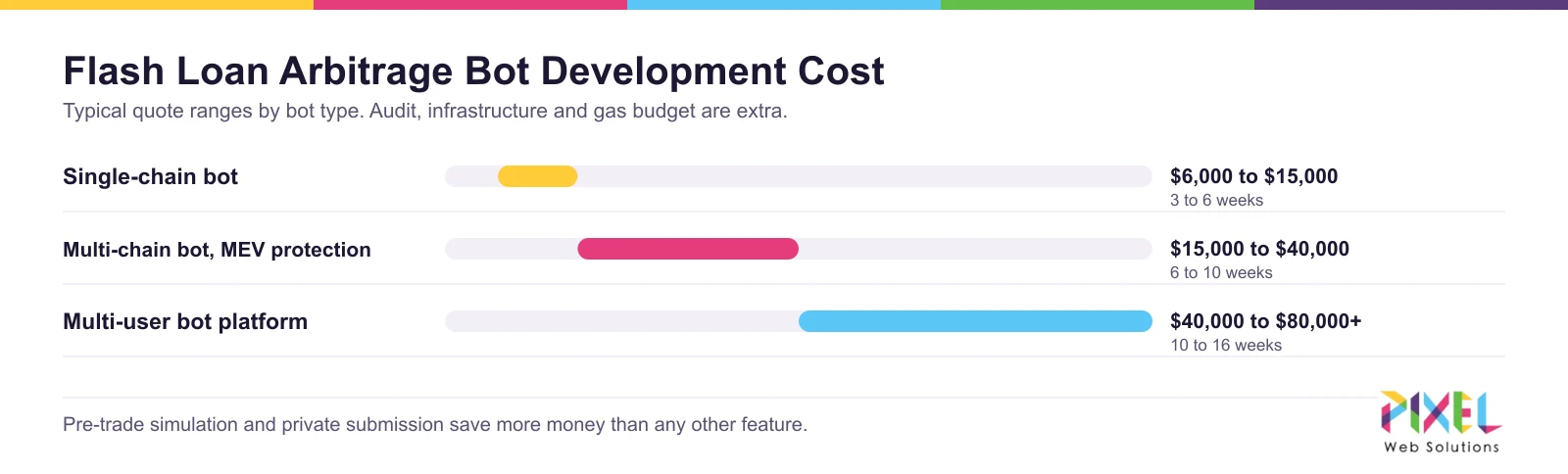
How Much Does Flash Loan Arbitrage Bot Development Cost?
Flash loan arbitrage bot development costs $6,000 to $80,000 or more, depending on how many chains, strategies and users the bot must support. These are typical quote ranges; your final price depends on scope.
| Bot type | What you get | Typical cost | Timeline |
|---|---|---|---|
| Single-chain bot | One chain, two or three DEXs, one flash loan provider, simulation and profit threshold | $6,000 to $15,000 | 3 to 6 weeks |
| Multi-chain bot | Several chains and DEXs, provider selection, MEV protection, admin dashboard | $15,000 to $40,000 | 6 to 10 weeks |
| Bot platform | Multi-user accounts, per-user contracts, subscription billing, white-label admin panel | $40,000 to $80,000+ | 10 to 16 weeks |
Beyond the build, budget for:
- Smart contract audit: strongly recommended before handling meaningful value.
- Infrastructure: premium RPC access or a dedicated node, since public endpoints are too slow for competitive arbitrage.
- Gas budget: native tokens on each chain to pay for transactions, including the ones that revert.
Is Flash Loan Arbitrage Still Profitable in 2026?
Yes, but far less easily than tutorials suggest. Here is the honest picture.
Competition is intense on Ethereum mainnet. Professional searchers run optimized bots with private order flow and bid most of each opportunity's profit to block builders to win inclusion. A simple two-DEX bot on mainnet rarely wins these auctions.
Opportunities persist where competition is thinner. Layer-2 networks such as Base and Arbitrum, newer chains, long-tail token pairs, newly launched pools and liquidation events still produce gaps that a well-tuned bot can capture.
Costs decide the outcome. Using the example above, a 0.9% price gap on $100,000 leaves roughly a quarter of the gross spread after swap fees, the flash loan fee and a competitive tip. Choose low-fee pools and providers and simulate relentlessly.
Profit is not guaranteed. Treat any seller promising fixed daily returns from a flash loan bot as a red flag.
Challenges Included in Crypto Flash Loan Arbitrage Bot Development
Market Volatility
Prices shift between the moment the bot spots a gap and the moment its transaction lands.
How to Overcome: Simulate against the latest block, set strict slippage limits and keep the profit check inside the contract so a stale trade reverts instead of losing money.
MEV Competition and Front-Running
Other bots watch the public mempool and copy or front-run profitable transactions.
How to Overcome: Submit through private channels such as Flashbots Protect or bundles, and bid tips based on each trade's expected profit rather than a fixed amount.
Smart Contract Vulnerabilities
Flash loan contracts hold no funds for long, but a flawed callback can still be abused. Flash loans are also the tool attackers use to exploit other protocols, as the $128 million Balancer V2 exploit showed in November 2025.
How to Overcome: Verify callers, keep no idle balances in the contract, test on mainnet forks and commission an independent audit before scaling.
Latency and Speed
Even a few hundred milliseconds of delay can mean the opportunity is gone.
How to Overcome: Use premium RPC endpoints or your own nodes close to the network, precompute routes and keep the scanner's code paths lean.
Failed-Transaction Costs
A reverted transaction still pays gas, and on Ethereum mainnet that adds up quickly.
How to Overcome: Pre-trade simulation, private submission (which can avoid paying for failed bundles) and running high-frequency strategies on low-fee chains.
Regulatory Issues
Arbitrage between public pools is generally lawful, but trading profits are taxable, and running a bot as a service for customers can bring financial regulation into play depending on your country.
How to Overcome It: Take local legal and tax advice before launch, especially if you plan to sell bot access or manage other people's funds.
Beware of "Free" Flash Loan Arbitrage Bots
Searches for free or open-source flash loan arbitrage bots often lead to YouTube tutorials that ask you to paste a contract into Remix, fund it and press start. These are usually scams. SentinelLABS documented one campaign in which AI-generated videos distributed obfuscated contracts that quietly made the scammer a co-owner, draining more than $900,000 from victims.
Warning signs include:
- Promised daily returns or "guaranteed" profit
- Obfuscated code, long hex strings or addresses assembled from fragments
- Instructions to send ETH to the contract before it does anything
- Comment sections full of identical success stories
Genuine open-source flash loan examples exist in protocol documentation and audited repositories, and they are educational templates, not money machines. If you want a bot that trades with real money, build it or have it built, and read every line before funding it.
Why Choose Pixel Web Solutions for Flash Loan Arbitrage Bot Development?
With years of experience in crypto trading bot development and DeFi development, we build flash loan arbitrage bots around your strategy rather than a shared template. Every bot ships with pre-trade simulation, a contract-level profit check, private transaction submission and a kill switch. We audit and penetration-test before mainnet, hand over the code and keys, and stay on to tune routes as the market shifts.
If you are also planning a trading venue of your own, our decentralized exchange development team builds the other side of the trade. And if you are still choosing where to play in DeFi, our guide to DeFi business ideas compares the main options. For a broader primer, see how to build a crypto trading bot.
Ready to build a flash loan arbitrage bot that only fires when the numbers work? Talk to our team for a scoped quote.
Frequently Asked Questions
Is flash loan arbitrage bot development worth it?
It can be, if you have a clear strategy, realistic expectations and the budget to compete. A well-built bot with good simulation and private submission can capture opportunities on L2s and long-tail pairs. A generic bot on Ethereum mainnet usually loses to professional searchers and wastes gas.
Is flash loan arbitrage still profitable in 2026?
Yes, in specific niches. Mainnet two-DEX arbitrage is heavily competed, while Layer-2 networks, new pools, long-tail pairs and liquidations still offer gaps. Net profit depends on fees, gas and the tip needed to win the block, so returns vary widely and are never guaranteed.
Is flash loan arbitrage legal?
Arbitrage between public liquidity pools is generally legal, and flash loans are a documented feature of protocols such as Aave. Using flash loans to manipulate prices or exploit protocol bugs is not arbitrage and can be illegal. Profits are taxable, and offering a bot service to customers may require licensing in some countries.
How much does it cost to develop a flash loan arbitrage bot?
Expect $6,000 to $15,000 for a single-chain bot, $15,000 to $40,000 for a multi-chain bot with MEV protection and a dashboard, and $40,000 to $80,000 or more for a multi-user platform. Audits, infrastructure and gas are additional running costs.
Which blockchain is best for flash loan arbitrage?
Ethereum has the most liquidity but the most competition. Arbitrum and Base offer low fees and growing volume, which suits high-frequency strategies. Solana offers very cheap transactions and its own flash loan protocols. Many bots run on several chains at once.
Do I need capital to run a flash loan arbitrage bot?
You do not need trading capital, because the flash loan supplies it. You do need native tokens for gas on each chain, a budget for failed transactions and funds for development, infrastructure and an audit.
Are free flash loan arbitrage bots safe?
Usually not. Many "free" bots promoted on YouTube and social media are wallet drainers disguised as trading contracts. Never fund a contract you cannot read and verify line by line.
How do you keep a flash loan arbitrage bot secure?
Restrict sensitive functions to the owner, verify the caller in every callback, keep no idle funds in the contract, submit transactions privately, test on mainnet forks and commission an independent smart contract audit before handling real value.
What is the difference between flash loan arbitrage and a flash loan attack?
Flash loan arbitrage trades between existing prices on public pools. A flash loan attack uses borrowed funds to manipulate prices or exploit a bug in a protocol. The tool is the same, but the intent and the legality are completely different.