Table of Contents
Over the past decade, the global payments landscape has shifted from slow, costly methods to fast, blockchain-powered solutions. With the increasing adoption of Web3 technology, various fintech companies and businesses are considering creating B2B stablecoin payment infrastructure platforms that offer faster transaction services, automated transaction settlements, and lower operational costs.
However, creating a B2B stablecoin payment system infrastructure requires careful planning, especially regarding development, legal, and infrastructure costs. Businesses must understand the various factors that influence the overall investment for building such a platform. In this blog, we will explore the costs associated with developing a B2B stablecoin infrastructure.
At Pixel Web Solutions, we have developed stablecoin payment infrastructure, multi-chain wallet development, and enterprise payment APIs for fintech startups and enterprises. Our development team has expertise in building secure B2B payment platforms with compliance support, smart contract integration, and settlement capabilities. Based on our project experience, the cost of developing a B2B stablecoin payment infrastructure depends on the architecture, compliance level, and customization.
Key Takeaways
- The total addressable market size for stablecoins in cross-border B2B transactions is estimated to be $17.9 Trillion+, which shows immense long-term growth prospects. (Source: grandviewresearch.com )
- The volume of B2B transactions via stablecoins is increasing exponentially. Estimates suggest over $226 Billion+ in B2B transactions are being made annually via stablecoins.
- The overall stablecoin market is estimated to reach a value of $300 Billion+, mainly due to fiat-backed stablecoins such as USDT and USDC.
- The overall volume of stablecoin transactions is touching a multi-trillion-dollar daily velocity, which shows the efficiency of the blockchain technology stack as a settlement layer.
- Corporates and financial institutions are increasingly looking to leverage stablecoin infrastructure for their treasury management needs.
Planning to build a stablecoin payment infrastructure for your business?
Our blockchain experts at Pixel Web Solutions can help you estimate the exact development cost based on your requirements, supported blockchains, and compliance needs.
What is B2B Stablecoin Payment Infrastructure?
A B2B stablecoin payment infrastructure is a blockchain-based financial system that enables businesses to send, receive, and manage payments using stablecoins. The main advantage of a B2B stablecoin payment infrastructure is that it allows for faster transactions between businesses in different regions. The blockchain technology that supports the B2B stablecoin payment infrastructure eliminates the need for multiple intermediaries in the process.
Major Components of a B2B Stablecoin Payment Infrastructure
- Stablecoin Wallets – Digital wallets that allow for the secure sending and receiving of stablecoins by businesses.
- Blockchain Network Integration – The blockchain network that supports the transactions between businesses.
- Smart Contracts – Smart contracts that allow for the execution of transactions between businesses.
- Payment Processing Engine – The main engine that supports the transactions between businesses.
- Enterprise API Integrations – APIs that help in integrating the platform with ERPs, accounting systems, etc.
- Compliance & Risk Monitoring Tools – Systems that help in KYC, AML screening, etc.
- Liquidity & Treasury Management – Tools that help manage the reserves of stablecoins and facilitate payment systems.
Leading B2B Stablecoin Payment Platforms
Several fintech and blockchain organizations have already developed the infrastructure needed for businesses to make payments using stablecoins. These organizations show how B2B stablecoin payment infrastructure can be used to simplify payments, settlements, and treasury management for businesses.
- Circle – Circle provides a stablecoin payment infrastructure using USD Coin, which enables businesses to send, receive, and manage digital dollar payments anywhere in the world.
- Ripple – Ripple provides enterprise payment solutions using its blockchain network, RippleNet, which enables faster payments and liquidity management for financial institutions.
- Fireblocks – Fireblocks is a digital asset infrastructure platform used by banks and fintech organizations for secure stablecoin payments, transfers, and treasury management.
- Stellar Development Foundation – The Stellar Development Foundation enables fast and affordable global payments using the Stellar Network, enabling businesses to send stablecoins anywhere in the world.
- Coinbase – Coinbase provides payment infrastructure and APIs that enable businesses to integrate stablecoin payments into their financial infrastructure.
The platform combines digital wallets, smart contracts, payment processing engines, and compliance mechanisms that help in the execution of settlements. As more enterprises seek efficient cross-border payment solutions and real-time settlements, there is a growing demand for creating a B2B stablecoin payments infrastructure.
Why B2B Stablecoin Payments Infrastructure Is Gaining Adoption In 2026?
Across the world, businesses are increasingly seeking stablecoin-based payment systems to transcend the barriers of traditional financial infrastructure. The traditional B2B payment system consists of many intermediaries, resulting in delayed payment settlement and increased transaction costs. Therefore, businesses are increasingly using the B2B stablecoin payment system for fast, transparent, and efficient financial transactions.
Faster Cross-Border Transactions
The traditional process of making international payments takes a few days to settle due to intermediaries like banks. The stablecoin payment system enables instant transactions on the blockchain network, allowing businesses to perform fast cross-border transactions.
Reduced Transaction Costs
The traditional process of making international payments or using bank transfers involves many service charges, conversion fees, and fees for intermediaries. The stablecoin payment system reduces transaction costs by avoiding intermediaries and using the blockchain network for transactions.
24/7 Payment Availability
Contrary to the conventional banking system, which can only operate within specific business hours, the stablecoin payment system allows for the decentralized network to operate 24/7. It ensures that enterprises can transact at any time without any delays.
Transparent and Traceable Transactions
Blockchain technology allows for a transparent system, which ensures that every transaction is recorded. Thus, it increases the level of financial accountability, making it easy for enterprises to track their transactions.
Programmable and Automated Payments
With the use of stablecoins, the payment system can be programmed to automate the payment system. It ensures that the business processes are simplified.
More businesses are adopting the stablecoin payment system because it offers many benefits. As a result, many startups are beginning to offer their own B2B stablecoin payment services. So, for those who are ready to create their own Enterprise Stablecoin Payments Infrastructure, here is the detailed cost breakdown to begin one.
Cost to Create a Stablecoin Payment Infrastructure
To build a B2B Stablecoin Payment Infrastructure, it is necessary to understand the investment needed at different levels of development. The amount will vary depending on how complex you want your platform to be, whether you are using a pre-built platform, modifying it, or creating a platform from scratch.
|
Deployment Type |
Cost (USD) | Timeline | For Whom to Prefer |
| Basic MVP | $25,000 – $50,000 | 8 – 12 weeks |
Startups or small businesses looking for a quick launch and market testing with minimal investment. |
|
MVP with Customized Features |
$50,000 – $100,000 | 12 – 16 weeks | Medium-sized businesses seek some custom features while keeping deployment relatively fast. |
| Custom Software with Advanced Features | $100,000 – $150,000 | 16 – 24 weeks |
Large enterprises or businesses require full customization, scalability, advanced security, and control. |
Want a clear cost estimate for your stablecoin payment platform?
The total cost depends on factors like wallet architecture, blockchain selection, compliance requirements, and customization. Get a detailed cost breakdown tailored to your business model.
- Basic MVP Version of Stablecoin Payment Infrastructure
A pre-built white-label or clone script with basic payment features will be used, making it a cost-effective option for businesses. It will cost a business between $25,000 to $50,000, and development will take between 8 to 12 weeks.
- MVP Version Stablecoin Payment Infrastructure with Customized Features
For businesses that want more features in their platforms, a white-label script will be used with customized features like dashboards, detailed reporting, more payment options, and ERP system integrations. This will cost a business between $50,000 to $100,000, taking about 12 to 16 weeks for development.
- Custom B2B Stablecoin Payment Software with Advanced Features
It is a highly customized version that is created from scratch to meet the specific requirements. The key features include advanced security measures, smart contract integration, multi-chain technology, and enterprise-level APIs. The time taken to create a custom platform will range from 16 to 24 weeks and costs between $100,000 to $150,000. The main advantages include scalability, control, and competitiveness.
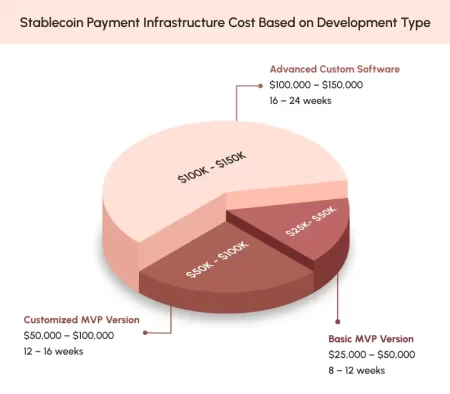
The version to choose depends on your budget, business goals, and timeframe. The white-label version can help you save time and costs, while the custom version offers scalability and control. With the increased need for B2B stablecoin payment solutions, investing in the right version can help your business become more efficient and competitive.
Cost Breakdown Based on the Core Components of a Stablecoin Payments Platform
Developing a B2B stablecoin payments platform has various core components that contribute to the total development cost. Understanding the development costs will help businesses budget appropriately for the platform to ensure it is developed to the required standards.
|
Core Component |
Approximate Cost (USD) | Description |
|
Custodial vs Non-Custodial Wallet Design |
$6,000 – $12,000 | For businesses needing secure storage of funds (custodial) or self-managed wallets for users (non-custodial). |
| Smart Contract and Token Integrations | $12,000–$20,000 |
Required for automated transactions, stablecoin issuance, and token operations; ideal for enterprises aiming for automation. |
|
Blockchain Network Selection |
$3,000 – $8,000 | Costs vary depending on public vs private chains; suitable for businesses needing optimal speed, cost, and scalability. |
| API Infrastructure for Enterprise Systems | $6,000 – $12,000 |
For integrating payments with ERP, treasury, and banking systems, preferred by medium to large businesses. |
|
Liquidity Routing and Settlement Logic |
$6,000 – $12,000 | Ensures smooth transaction settlements and routing between stablecoins and fiat; crucial for high-volume platforms. |
| Risk Monitoring and Transaction Screening | $5,000 – $9,000 |
For compliance with AML/KYC regulations and fraud prevention; essential for regulated B2B platforms. |
| Security Architecture | $7,000 – $15,000 |
Advanced security measures, encryption, and multi-layer protection; ideal for enterprises handling high-value transactions. |
Custodial vs. Non-Custodial Wallets
Developing a custodial wallet or a non-custodial wallet is a significant consideration. A custodial wallet typically costs between $6K-$12K. The platform will be responsible for the wallet. A non-custodial wallet will give users full control of the wallet. The users will be responsible for the wallet.
Smart Contract and Token Integrations
Smart contracts will be required to automate payments. The integration will be done securely to ensure that payments are processed correctly. The integration will cost the platform between $12K-$20K.
Blockchain Network
Choosing a blockchain will be essential. The blockchain will determine the speed of transactions. It will either be a public blockchain, a private blockchain, or a consortium blockchain. The cost of the platform is between $3K-$8K.
API Infrastructure for Enterprise Systems
The APIs will be used for integrating the stablecoin payment platform with different systems, like ERP systems, treasury systems, or banking systems. It will cost around $6K–$12K. This will help a medium or large-sized business track transactions smoothly.
Liquidity Routing and Settlement Logic
The logic for routing between different stablecoins and fiat currencies needs to be implemented efficiently. This will help a business utilize the liquidity optimally and ensure timely settlement. To integrate such a component would cost from $6K–$12K.
Risk Monitoring and Transaction Screening
Transaction screening for fraud, money laundering, or any other suspicious activities needs to be implemented for a business platform. To comply with AML/KYC regulations, it may cost between $5K–$9K.
Security Architecture
A business needs a robust security architecture that includes encryption, key management systems, and multi-factor authentication. It is a must for a business since it needs to ensure security for the funds or users, which costs around $7K–$15K.
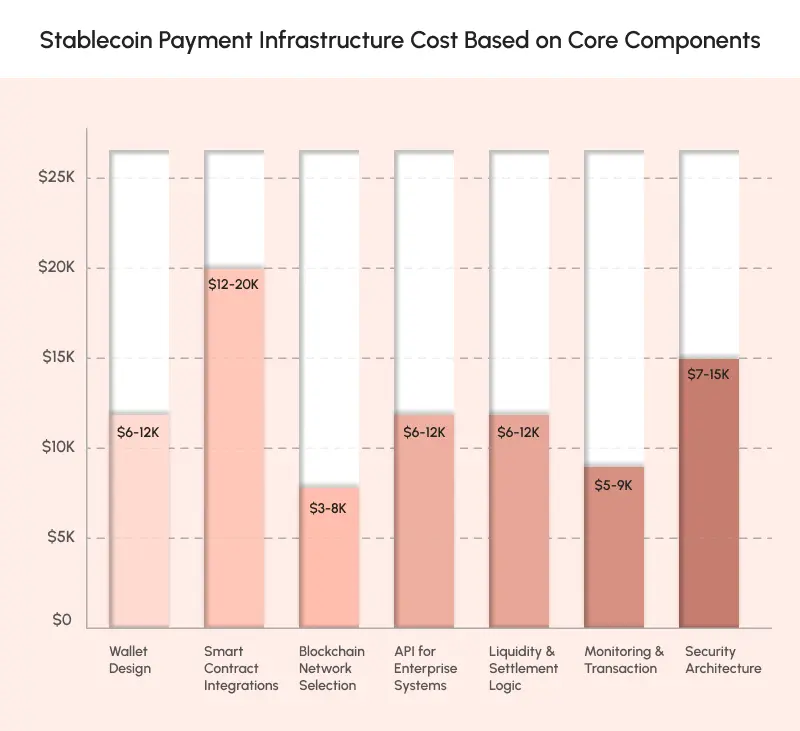
Each core component plays an important part in the overall functionality, security, and compliance of the platform. Therefore, by allocating the right budget to these components, a business can create a secure, scalable, and efficient B2B stablecoin payment infrastructure. Hence, in the face of increasing demand for such platforms, strategic allocation of resources to these factors can guarantee a reliable and competitive advantage for a business in the long run.
Licensing Cost to Create a B2B Stablecoin Payments Infrastructure
Licensing is an important part of B2B stablecoin payments infrastructure Development. It ensures legal compliance, builds trust with clients, and allows smooth cross-border operations. The cost may vary depending on the type of licence, jurisdiction, and regulatory compliance.
|
License Type |
Approximate Cost (USD) | Description |
| Money Transmitter / Payment License | $2,000 – $5,000 |
Required for platforms handling fiat-to-stablecoin or stablecoin-to-fiat conversions. Suitable for startups entering regulated markets. |
|
MSB / FinTech Registration |
$1,000 – $3,000 | Basic registration for operating as a money service business. Ideal for small businesses testing the market. |
| Cross-Border Licensing & Compliance | $2,000 – $5,000 |
For businesses planning to operate internationally. Ensures compliance with multiple jurisdictions. |
|
Other Regulatory Approvals (KYC/AML, PCI DSS) |
$1,500 – $3,500 |
Mandatory for risk management and transaction monitoring; suitable for all regulated B2B payment platforms. |
Money Transmitter / Payment License
A payment license is a must-have for businesses that need fiat-to-stablecoin or stablecoin-to-fiat conversions. The cost for a license will be around $2,000 to $5,000, depending on the state or country. This license is preferred by most startups in the regulated space for a legal entry into the payment services space.
MSB / FinTech Registration
A fintech license is preferred for small businesses entering the space as a money service business, which will cost around $1,000 to $3,000, thereby ensuring minimal compliance requirements for a legal entry into the B2B payment gateway.
Cross-Border Licensing & Compliance
A cross-border license is a must for businesses planning a cross-border entry into the space, which will cost around $2,000 to $5,000 for a legal entry into the space.
Other Regulatory Approvals (KYC/AML, PCI DSS)
Compliance with risk management, anti-money laundering measures, and payment security standards is mandatory. These approvals generally cost $1,500 to $3,500 and are essential for all regulated B2B stablecoin platforms.
(Source -Legalclarity.org)
In a nutshell, a license is a must-have for any business in the B2B stablecoin space, and although the cost may vary depending on the license type and jurisdiction, it is a necessary investment for a safe entry into the space.
Cost to Build a B2B Stablecoin Payments Infrastructure Based on Country
The cost of building a B2B stablecoin payments infrastructure may differ depending on the country where the platform is being built or operated. It is due to a number of factors that affect the cost.
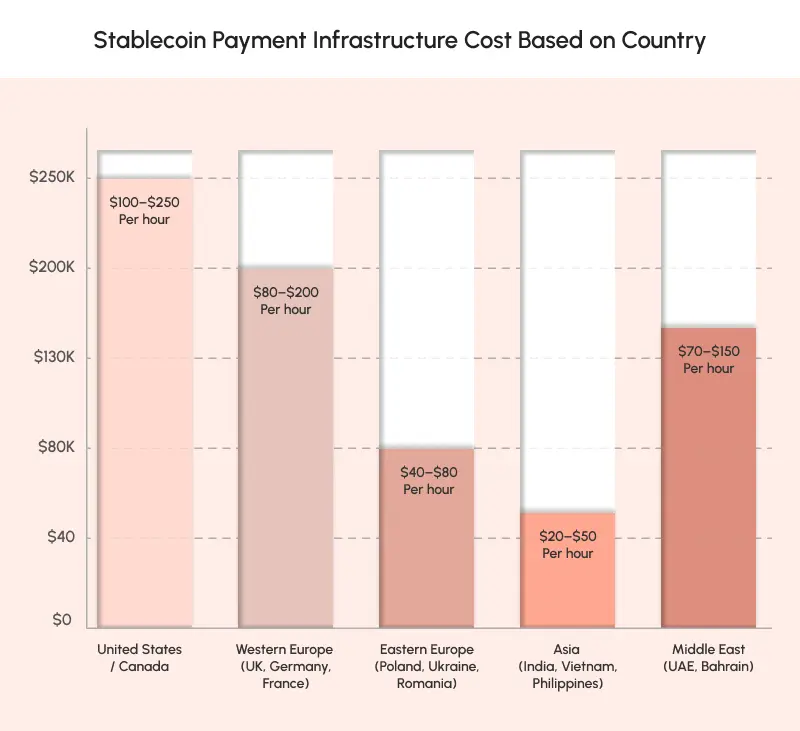
For instance, businesses may select countries that provide cost efficiency along with expertise in blockchain technology for building a B2B stablecoin payments infrastructure.
|
Country / Region |
Approximate Development Cost (USD) | Reasons to Choose |
| United States / Canada | $100 – $250 / hour |
High-quality development, strong compliance standards, and advanced blockchain expertise. |
|
Western Europe (UK, Germany, France) |
$80 – $200 / hour | Strong regulatory frameworks and experienced fintech development teams. |
| Eastern Europe (Poland, Ukraine, Romania) | $40 – $80 / hour |
Skilled blockchain developers with moderate development costs. |
|
Asia (India, Vietnam, Philippines) |
$20 – $50 / hour | Cost-effective development with a large pool of blockchain engineers. |
| Middle East (UAE, Bahrain) | $70 – $150 / hour |
Emerging fintech hub with supportive crypto regulations and infrastructure. |
The selection of a development location for a B2B stablecoin payments infrastructure is a key aspect that helps in optimizing the cost of building a B2B stablecoin payments infrastructure. Many startups and enterprises prefer regions with strong blockchain talent and cost-efficient development services to achieve a balance between quality, compliance, and budget.
How to Create a B2B Stablecoin Payments Infrastructure – Complete Cost Analysis
To build a B2B Stablecoin Payments Infrastructure, several structured phases are necessary, each with its own set of cost factors depending on their complexity, compliance, and security requirements.
|
Phase |
Timeline | Cost (USD) |
What It Includes |
| Strategy & Security Planning | 2 – 3 weeks | $5,000 – $8,000 | Market research, competitor analysis, business model evaluation, risk assessment, security framework definition, and initial infrastructure planning |
| Architecture & Regulatory Planning | 3 – 4 weeks | $8,000 – $12,000 | Technical architecture design, blockchain network selection, wallet type definition, KYC/AML compliance research, licensing consultation |
| Core Infrastructure Development | 6 – 8 weeks | $45,000 – $70,000 | Payment engine development, wallet management system, smart contract deployment, multi-chain integration, enterprise API development |
| Compliance & Features Integrations | 2 – 3 weeks | $12,000 – $20,000 | KYC/AML system integration, transaction monitoring, reporting dashboards, enterprise API integrations, optional features (loyalty, rewards) |
| Testing & Smart Contract Audits | 2 – 3 weeks | $8,000 – $12,000 | Functional, performance, and security testing, vulnerability scanning, and third-party smart contract audits |
| Deployment & Maintenance | Ongoing | $5,000 – $10,000/year | Platform deployment, server monitoring, security updates, bug fixes, infrastructure scaling, and customer support |
Phase 1: Strategy & Security Planning
You will lay out the roadmap for your B2B Stablecoin Payments Infrastructure, as well as its security protocols, ensuring that your platform is developed on a secure, scalable, and compliant basis, minimizing potential pitfalls in the future. The cost will vary from $5,000 to $8,000, depending on the complexity of your platform and its security.
- Market Research and Competitor Analysis – Gain a clear understanding of the target market and industry standards.
- Business Model Evaluation – Define revenue streams and operational strategy.
- Risk Assessment & Security Framework – Identify vulnerabilities and establish protective measures.
- Infrastructure Planning – Outline technical and system requirements.
Phase 2 – Architecture & Regulatory Planning
Secondly, the technical architecture for the platform will be designed, keeping in view the compliance with KYC/AML regulations and licensing. The cost would range between $8,000 to $12,000, covering legal consultations, compliance checks, and architecture planning.
- Design Technical Architecture – Blueprint for Wallets, Payment Engines, and Integrations.
- Blockchain Network Selection – Selection of the most appropriate Blockchain Networks.
- Wallet Design – Decisions on Custodial/Non-Custodial Wallets.
- Regulatory Compliance – Legal consultation for Licensing and Cross-Border Payments.
Phase 3 – Core Infrastructure Development
The core infrastructure for the platform will be developed, which includes Wallets, Payment Engines, and Blockchain Integrations. Costs range from $40,000 to $70,000, depending on multi-chain support, smart contracts, and enterprise API requirements.
- Payment Engine Development – Core Logic for Payment Processing.
- Wallet Management System – Secure Management of Funds.
- Smart Contract Deployment – Enablement of Transactions and Agreements.
- Multi-Chain and API Integrations – Connect with ERP, treasury, and banking systems.
Phase 4 – Compliance & Features Integrations
In phase four, further compliance and feature integrations are carried out, which may include optional features for a better business experience. The cost for this phase ranges from $12,000 to $20,000, as it involves integrations with third-party services and software.
- KYC/AML System Integration – Ensures that the company complies with regulations by verifying user identities and monitoring financial activities.
- Risk Monitoring & Transaction Screening – Helps to detect suspicious transactions and prevent fraudulent activities.
- Reporting Dashboards – Offers insights to the company, which can be used to make better business decisions.
- Enterprise API Workflows – Enables seamless integration with client systems and supports additional features such as reward programs and automation.
Phase 5 – Testing & Smart Contract Audits
Prioritizes platform stability, security, and reliability through comprehensive testing and monitoring. Also, conduct thorough smart contract audits to detect and address vulnerabilities, ensuring the integrity of transactions and building trust among users. The cost for this phase ranges from $8,000 to $12,000.
- Functional & Performance Testing – Ensures the platform runs smoothly and can handle high transaction volumes.
- Security Testing & Vulnerability Scans – Detects potential risks and strengthens the platform against possible attacks.
- Third-Party Smart Contract Audits – Ensures smart contracts are secure and reliable on the blockchain.
Phase 6 – Deployment & Maintenance
In the final phase, the platform is deployed to ensure it operates continuously and functions correctly. The team conducts tests and makes adjustments as needed to maintain stability and performance. The cost of maintaining the platform is between $5,000 to $10,000/year.
- Platform Deployment – The stablecoin payment platform is launched for real-time transaction processing.
- Monitoring & Updates – Continuous monitoring ensures smooth transactions, with regular updates for performance and security.
- Scaling & Customer Support –Infrastructure is built to efficiently handle growing transaction volumes, with support teams ready to assist users.
- Ongoing Maintenance – Regular maintenance fixes bugs, upgrades features, and ensures reliable platform operation.
Each phase contributes uniquely to the development of a secure, compliant, and scalable B2B stablecoin payments infrastructure. The factors that contribute to the costs help businesses budget properly to ensure a high-quality platform that is competitive with the growing demand for B2B stablecoin payments.
Need help building a secure and scalable stablecoin payment system?
Pixel Web Solutions has experience developing enterprise payment infrastructure, multi-chain wallets, and crypto payment gateways for global clients.
Marketing and Outreach Costs for a B2B Stablecoin Payments Infrastructure
Marketing plays a crucial role in driving adoption for a B2B Stablecoin payments infrastructure. Once you have completed the development process, you need to do marketing to attract enterprise clients.
|
Marketing Activity |
Timeline | Approximate Cost (USD) |
|
Branding & Website Development |
2 – 3 weeks | $2,000 – $6,000 |
| Content Marketing & SEO | Ongoing |
$1,500 – $5,000 |
|
Paid Advertising (PPC & Social) |
2 – 12 weeks | $2,000 – $8,000 |
| PR & Outreach Campaigns | 2 – 6 weeks |
$1,500 – $5,000 |
|
Partnerships & Business Development |
Ongoing |
$2,000 – $6,000 |
| Social Media Marketing | Ongoing |
$5000 – $15000 |
Branding and Website Development
You need to create a professional brand identity, UI/UX design, and a conversion-optimized website for your platform. Businesses usually spend between $2,000 – $6,000 to create a strong first impression and establish credibility with enterprise clients.
Content Marketing & SEO
Content marketing strategies, such as blogs, case studies, and landing pages, help drive organic traffic to your platform while educating your potential clients. The cost ranges between $1,500 – $5,000, depending on content volume, keyword research, etc.
Paid Advertising & Social Media
Targeted advertising on platforms such as Google Ads and LinkedIn can be an effective way to generate leads quickly. A budget of $2,000 – $8,000 is usually required for running paid advertising campaigns.
PR & Outreach Campaigns
Public relations and outreach programs play an important role in gaining the trust and confidence of people in the fintech industry. A budget of $1,500–$5,000 is required to run PR and outreach programs.
Partnerships & Business Development
Partnerships with fintech companies, payment providers, and enterprises are essential for scaling the user base. This may include outreach programs and may cost approximately $2,000 – $6,000.
Marketing and outreach are critical investments for ensuring the success of a B2B stablecoin payments infrastructure. A proper marketing strategy not only helps in acquiring users but also ensures the growth and success of a business in the ever-evolving digital payments space.
Hidden and Recurring Costs in a B2B Stablecoin Payments Infrastructure
Apart from the initial development and marketing cost, operating a B2B stablecoin payments platform incurs additional, often unseen, expenses that are essential for the continued operation of the business. Properly estimating these costs ensures sustainable operations and prevents unexpected budget overruns.
|
Recurring / Hidden Cost Factor |
Approximate Cost (USD / year) |
| Cloud Hosting & Server Infrastructure |
$1,000 – $5,000 |
|
Maintenance & Technical Support |
$1,500 – $6,000 |
| Smart Contract Upgrades & Blockchain Fees |
$500 – $3,000 |
|
Compliance & Regulatory Updates |
$1,000 – $4,000 |
| Security Monitoring & Incident Response |
$1,000 – $5,000 |
|
Transaction Fees / Liquidity Management |
$1,000 – $7,000 |
Cloud Hosting & Server Infrastructure
Maintaining a robust server infrastructure and cloud hosting is essential for the continued operation of the business, as the server infrastructure must be capable of handling high transaction volumes. The cost can range from $1,000 to $5,000 annually, depending on the scalability, server uptime, and server redundancies.
Maintenance & Technical Support
Continued maintenance and technical support are essential for the continued operation of the business, as the platform must be free from bugs for seamless operation. The cost can range from $1,500 to $6,000 annually, covering the cost of developer hours, system monitoring, and customer support.
Smart Contract Upgrades
Smart contract upgrades are essential for the continued operation of the business, as smart contracts are often required to ensure security on the blockchain network. The cost of blockchain fees, often referred to as gas fees, can range from $500 – $3,000.
Compliance & Regulatory Updates
Regulatory landscapes evolve, requiring periodic audits, KYC/AML updates, and legal consultations. The costs involved may range from $1,000 to $4,000 annually.
Security Monitoring & Incident Response
The B2B stablecoin payments system must guard against hacks, malware, or system failures. It may require periodic security monitoring tools. The costs may range from $1,000 to $5,000 annually.
Transaction Fees & Liquidity Management
The B2B stablecoin payments system may need to facilitate payments across various blockchain networks. It entails liquidity management costs and transaction fees. The costs may range from $1,000 to $7,000 annually.
It is important to consider the hidden costs involved in the B2B stablecoin payments system. This will help ensure the sustainability and reliability of the B2B stablecoin payments system.
Total Cost Analysis of a B2B Stablecoin Payments Infrastructure
The table below presents a clear and comprehensive view of all costs and timelines associated with developing a B2B stablecoin payments platform.
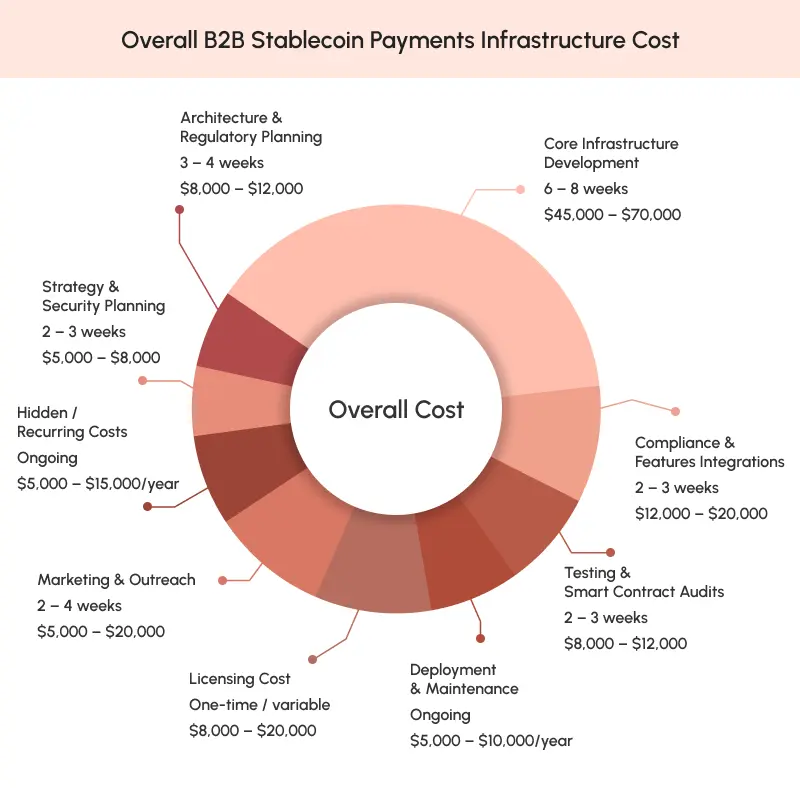
After going through all the detailed descriptions associated with development phases, licensing costs, marketing costs, and other hidden costs and recurring costs, this table presents a clear view of all costs and timelines associated with developing a B2B stable coin payments platform.
|
Phase / Cost Area |
Timeline | Cost (USD) |
| Strategy & Security Planning | 2 – 3 weeks |
$5,000 – $8,000 |
|
Architecture & Regulatory Planning |
3 – 4 weeks | $8,000 – $12,000 |
| Core Infrastructure Development | 6 – 8 weeks |
$45,000 – $70,000 |
|
Compliance & Features Integrations |
2 – 3 weeks | $12,000 – $20,000 |
| Testing & Smart Contract Audits | 2 – 3 weeks |
$8,000 – $12,000 |
|
Deployment & Maintenance |
Ongoing | $5,000 – $10,000/year |
| Licensing Cost | One-time / variable |
$8,000 – $20,000 |
|
Marketing & Outreach |
2 – 4 weeks | $5,000 – $20,000 |
| Hidden / Recurring Costs | Ongoing |
$5,000 – $15,000/year |
It allows businesses to easily understand the total investment needed, plan budgets effectively, and make informed decisions to launch and maintain a secure, scalable, and fully compliant platform. But now, you may have a question…
How Businesses Make Profit from a B2B Stablecoin Payments Infrastructure
Businesses can make a profit from a B2B stablecoin payment infrastructure. Investing in a B2B stablecoin payments infrastructure not only benefits businesses financially but also provides a platform to generate more income.
Transaction Fees
The B2B stablecoin payments platform can generate income through fees charged on transactions carried out on the platform. Although the fees are low on a single transaction, the income earned on a large number of transactions is significant.
Subscription or Licensing Fees
The B2B stablecoin payments platform can provide its services to other businesses. This will generate income through subscription fees.
Value-Added Services
Adding services like reporting or analytics can enable businesses to charge customers for the services. Such services can also boost user engagement for the business.
Enterprise Partnerships
Partnering with banks or treasury services can enable businesses to create new revenue streams via partnership fees or referral fees.
By utilizing these profit mechanisms, businesses can create substantial revenues while providing an efficient, secure, and fast means of making B2B stablecoin payments. By hiring an experienced crypto payment gateway development company like Pixel Web Solutions, you can be sure to receive a top-notch solution that is optimized for profitability and enterprise scalability. Partnering with us allows you to focus on growth while we handle the technical complexities of your stablecoin payment infrastructure.
Why Choose Pixel Web Solutions to Launch an Enterprise-Ready Stablecoin Payment Infrastructure Platform?
With 12+ years of experience, Pixel Web Solutions helps businesses to venture into the blockchain payments industry, ensuring speed, security, usability, and scalability. As a leading crypto payment gateway development company, we create custom crypto payment systems that integrate easily with your business. Our systems work with different blockchain networks and follow all necessary regulations. With a dedicated team of 120+ blockchain and fintech experts, we created a B2B stablecoin payment solution for fintech companies in Europe, the USA, the UAE, and enabling smooth international transactions with KYC/AML checks and robust security measures. By working with us, your business can focus on growth while we handle the complexities of your stablecoin payment infrastructure.
- Achievements – Completed over 560+ projects for clients globally, with zero downtime.
- Custom Built Platforms – Develop custom-built platforms that suit your business requirements.
- Regulatory Compliance – Ensure that your business complies with all relevant regulations, including KYC/AML and payment regulations.
- Advanced Security – Ensure that your business is protected with the highest level of security features.
- Fast Time-to-Market – Offer white-label as well as custom-built solutions for fast time-to-market.
- Multi-Chain Support – Seamlessly interact with different blockchains and stablecoins.
- Scalability – Built with a capacity for increasing transactions and business growth.
- Ongoing Support – Providing maintenance, updates, and technical assistance for smooth operations.
If you are interested in learning more about the exact cost and timeline for your business requirements, our experts are ready to help you efficiently create a successful B2B stablecoin-based payment platform. Connect with us today and receive a customized quotation for a successful B2B Stablecoin Payment Platform.
Conclusion
Building a B2B Stablecoin infrastructure in 2026 empowers enterprises to embrace modern finance like blockchain-based payments, fast cross-border transactions, and automated settlements, allowing them to operate more efficiently in the modern, digital financial ecosystem. By partnering with a reliable crypto payment gateway development company, you can unlock new growth opportunities in the evolving global fintech landscape.
Looking to launch your own stablecoin payment platform?
Whether you’re exploring a white-label solution or need fully custom, enterprise-grade infrastructure, our team can help you build a secure and compliant stablecoin payment system tailored to your needs.
Start Your Stablecoin Project Today!
FAQ
- Can a B2B stablecoin platform handle cross-border payments?
Yes, stablecoins are best suited for cross-border payments since they do not involve delays associated with banking, conversion of currencies, or high fees. This makes B2B cross-border payments faster, cheaper, and transparent.
- Which stablecoins are commonly used for B2B payments?
Some of the popular stablecoins used for B2B payments are Tether (USDT), USD Coin (USDC), and Binance USD (BUSD) due to their liquidity, stability, and acceptance.
- How secure are B2B stablecoin transactions?
The B2B stablecoin transaction is secure through blockchain immutability, multi-signature wallets, smart contract auditing, and enterprise-grade encryption.
- Can existing ERP or accounting systems integrate with stablecoin payments?
Yes, all B2B stablecoin solutions offer API integrations for existing ERP and accounting systems. The integrations make the process seamless for the enterprise.
- Is regulatory compliance required for B2B stablecoin payments?
Yes, compliance with KYC/AML regulations, licensing, and cross-border payment laws is important. Non-compliance can lead to severe financial and reputational damage. A professional development partner is a necessity in such a case.