Table of Contents
Key Takeaways
- The Cost to build a Prediction Market Platform can range between $25,000 to $150,000, depending on your chosen development approach.
- The prediction marketplace is a smart contract-based platform where users usually place bets on the trending outcomes.
- Trading engines, smart contracts, liquidity systems, and security systems play an important role in the performance and scalability of the prediction market platforms.
- Multiple revenue streams like trading fees, market creation fees, ads, and transaction-based earnings make these platforms profitable.
Over the recent years, we have witnessed how prediction markets have moved from just an emerging concept into a serious business, right? In fact, recent reports showed how some bets on platforms like Polymarket have even triggered extreme reactions. This just shows how engaging and influential these platforms have become.
Use cases of these prediction platforms are expanding beyond sports into politics, economics, and real-world events. This makes many businesses explore the potential of building their own platforms.
But the big question is, “How much investment does it cost to build a prediction market platform successfully?”
In this blog, we break down everything you need to know about prediction market platform development costs, including development approaches and hidden expenses.
At Pixel Web Solutions, we have over a decade of experience in building secure and high-performing platforms in the blockchain and fintech space. With our hands-on expertise in developing prediction market platforms, we have provided a detailed insight into “how much does it cost to build a prediction market platform in 2026?” So, let’s begin with
Key Market Insights
- A joint report from Dune Analytics and Keyrock highlights the growth of prediction markets. The monthly trading volume has surged from $100 million to $13 billion within the last two years, which is approximately 130x faster.
- According to DailyCoin, many non-sports categories are now dominating prediction markets, exploring into various industries with a surge of 17x in trading volume.
- A collaborative report from Dune, Keyrock, and KPMG highlights that newly launched prediction market platforms have surpassed $6.4 billion in trading volume within just 50 days. This clearly demonstrates the massive market demand they have in this space.
Prediction Market Platform Development – A Quick Glance
Prediction Market Platform Development is the process of developing a smart contract-based platform that enables users to place bets on outcomes. This creates a data-driven ecosystem where collective intelligence meets real-time decision-making. From predicting financial trends to forecasting real-world events, these platforms are designed to transform user opinions into actionable market insights. The prediction market development involves integrating trading mechanisms, real-time data feeds, liquidity models, and secure smart contracts to ensure transparent operations.
Why Businesses Are Investing in Prediction Market Platforms
The prediction market platform development is gaining traction in the digital ecosystem. With a unique way of money-making potential, these platforms are raising both the user participation and engagement rates. This makes prediction market platform development attractive for forward-thinking businesses. Besides, here is a list of justifying reasons stating why the Prediction Marketplace development is the best choice.
- Prediction markets are naturally interactive and participative in nature. The users tend to actively participate by predicting outcomes and tracking results. This leads to higher user retention rates, increased session timings, and community-focused growth.
- These platforms come with multiple revenue streams such as trading fees, market creation fees, and other premium features. This follows consistent revenue and gives out scalable monetization opportunities.
- The prediction marketplace is still in their beginning area, especially focused only on some niche areas. Entering the market now will allow you to position your brand strongly among less competition.
- From finance, politics, to entertainment, these prediction markets can be applied across a wide range of industries. This allows you to enter across multiple sectors, gathering a diverse set of audiences.
This might have made it clear that the prediction market platform development isn’t just a trend, but a reliable investment. This combines engagement and intelligence, making them highly attractive for forward-thinking businesses.
How much does it cost to build a Prediction Market Platform?
|
Development Approach |
Estimated Timeline | Estimated Cost |
| MVP Approach with Basic Features | 8 – 12 Weeks |
$25000 to $50000 |
|
MVP Approach with Advanced Features |
12 – 16 Weeks | $50000 to $100,000 |
| Prediction Market Platform Development From Scratch | 16 – 24 Weeks |
$100,000 to $150,000 |
White Label/ MVP Styled Prediction Market Development with Basic Feature
This approach is best suited for businesses looking to launch their own platform quickly with minimal investment and risk. A basic MVP focuses only on essential functionalities such as simple trading mechanisms, limited market creation, and a straightforward user interface. This costs around $25,000 to $50,000 and might take 8 to 12 weeks of development. The customization here might be low, as it comes with only a basic set of features. This is the best option for startups that are looking to test the waters with minimal investment.
White Label/ MVP Styled Prediction Market Development with Basic Features
This development model is a bit more advanced than the basic version. This might cost around $50,000 to $100,000 and can take up to 12-16 weeks to successfully launch the rediction Market Platform. This includes an enhanced UI/UX, advanced trading functionalities, and analytical tools. This approach is best for businesses that want to launch their own prediction market in a cost-effective manner, yet with advanced features and functionalities.
Prediction Market Platform Development from Scratch
Building a prediction market platform from scratch is a fully customized approach. This approach might cost around $100,000 to 150,000, and can take up to nearly 16 to 24 business weeks. This approach is for businesses with a long-term vision and unique requirements. Every component, from base architecture to trading engine, is built from the ground up here. This method offers complete control over features, and integrations, enabling the platform to stand out in a competitive market. Businesses that have long-term vision and goals can opt for this method to build a robust and scalable platform.
Want a Clear Cost for Your Prediction Platform?
Every prediction market platform comes with different cost factors. Share your requirements and get a tailored estimate based on your features, scalability goals, and business model.
Feature-Wise Cost Breakdown of a Prediction Market Platform Development
The overall cost of building a prediction market platform typically ranges between $5,000 to $30,000, depending on the depth of feature integration. Each of these components plays a direct role in defining platform performance and scalability. Here’s a quick breakdown of how each feature contributes to the development cost,
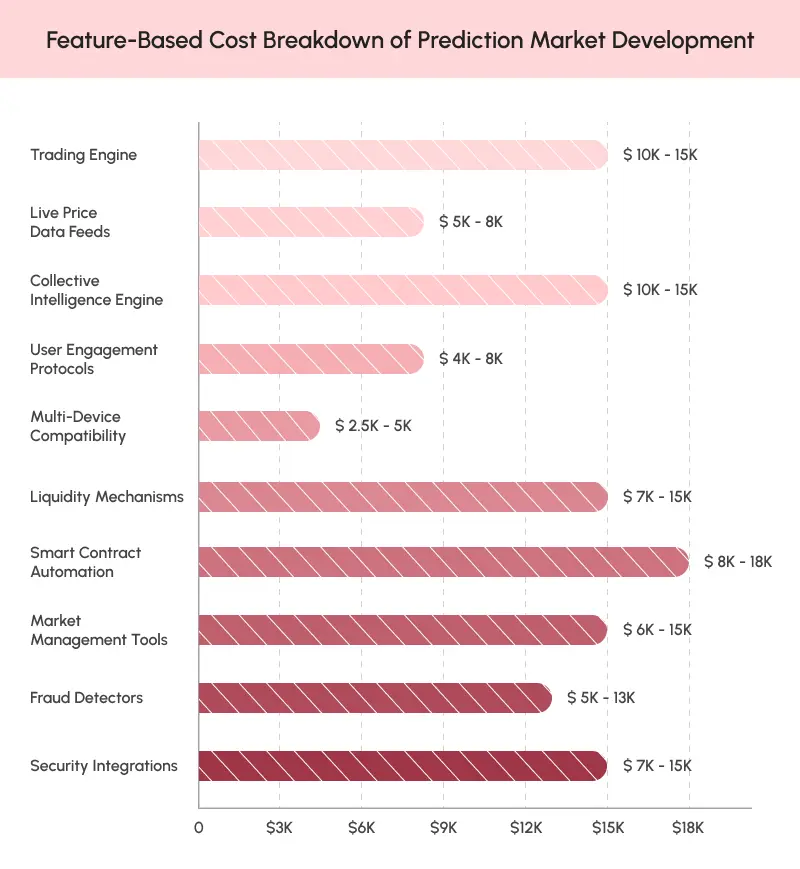
Trading Engine – This is the important aspect of the platform, which might fall between $10,000 – $15,000. The users here place bets, trade positions, and interact with markets.
Building a trading engine requires a high-performing backend architecture.
Live Price Data Feeds – Prediction markets rely on live data updates to reflect changing probabilities and outcomes. Integration with external APIs, or oracles, might cost around $5,000 – $8,000.
Collective Intelligence Engine – This feature aggregates user predictions and converts them into market probabilities. Designing these algorithmic models might cost around $10,000 – $15,000.
User Engagement Protocols – Incorporating this might cost around $4,000 – $8,000. These protocols have features like rewards, leaderboards, notifications, and gamification elements to keep users active.
Multi-Device Compatibility – This costs around $2,500 – $5,000 and ensures that the platform works smoothly across mobile, tablet, and desktop. Cross-browser and cross-device testing is done here.
Liquidity Mechanisms – Liquidity is essential to ensure that the user has enough participation for smooth trading. Integration of AMMs, liquidity pools, and market balance might cost around $7,000 – $15,000.
Smart Contract Automation – This feature might automate trade execution, fund handling, and outcome settlement on the blockchain. This costs around $8,000 – $18,000.
Market Management Tools – This might cost between $6,000 – $15,000, and has all those admin-side controls for creating, editing, and monitoring prediction markets functionalities.
Fraud Detection Systems – These systems will help in identifying suspicious activities, bot usage, and manipulation attempts. Investing a sum of $5,000 – $13,000, one might recognize patterns.
Security Integrations – This protects user data, transactions, and platform integrity. Incorporating essential security elements is essential and might cost between $7,000 – $15,000, depending on business requirements.
The cost spent on the above-mentioned features isn’t just an expense, but a form of investment layer. Minimizing here might reduce bills, but it often leads to higher risks in the future.
Region-Based Cost Breakdown of a Prediction Market Platform Development
The cost of developing a prediction market platform can vary significantly based on the geographical location of your development team. One of the primary factors influencing this variation is the hourly rate of developers, which differs across regions based on expertise, demand, and cost of living. Here is a quick breakdown of the list of top countries and the hourly rate charged by them.
|
Top Countries |
Hourly Rate |
| HongKong |
$60 – $120 |
|
European Countries |
$70 – $130 |
| India |
$20 – $30 |
|
Japan |
$80 – $140 |
| North America |
$80 – $200 |
|
Australia |
$50 – $90 |
| UAE & Middle Eastern Countries |
$40 – $110 |
|
Singapore |
$70 – $130 |
Choosing the right region requires balancing cost, technical expertise, regulatory familiarity, and project scalability. While some regions offer cost-effective development, others bring deep domain expertise and advanced infrastructure to the table. So, choose a development team that fits with your budget, project requirements, and gives an innovative and compliant approach.
Regulatory and Licensing Cost Analysis for Developing Prediction Market Platforms
In prediction market platform development, having legal and regulatory compliance is essential. From obtaining licenses to staying with evolving legal frameworks, these costs ensure your platform operates securely and legally across regions. The total estimated cost for this category comes around $15,000 to $30,000, and might vary based on several components. Investing in compliance prevents legal complications while building long-term trust with users and investors. Here’s a quick breakdown of the key regulatory and licensing expenses,
|
Regulatory Phases |
Estimated Cost |
| Licensing Costs |
$4,000 – $12,000 |
|
Legal Setup |
$2,000 – $6000 |
| Regular Legal Audits |
$1,500 – $4,000 |
|
Ongoing Regulatory Updates |
$1,000 – $3,000 |
| Regional Access Licenses |
$1,500 – $5,000 |
Licensing Costs – Estimated at around $4,000 – $12,000, this cost covers obtaining the primary operational licenses required to legally run a prediction market platform. Depending on the jurisdiction, this may include gaming or financial-related licenses.
Legal Setup – For legally branching out, the investment can range from $2,000 to $6,000. This includes company registration, preparing conditions, privacy policies, and compliance documentation.
Regular Legal Audits – Periodic legal review is essential to keep your platform running with current laws without any pull-backs. These audits may cost around $1.500 to $4,000 and will help you to identify risks and avoid penalties.
Ongoing Regulatory Updates – Frequent updates are essential and might cost around $1,000 – $3,000. The regulations in prediction markets and blockchain evolve frequently. This cost can be used for updating policies, terms, and platform operations in line with new rules.
Regional Access Licenses – Investing around $1,500 – $5,000 is essential to expand your services across countries. If your platform targets multiple countries, additional region-specific licenses may be required to operate legally in those markets.
Marketing Costs to Consider When Launching a Prediction Market Platform
Launching a prediction market platform successfully requires huge visibility, traction, and user trust. A well-planned marketing strategy ensures your platform reaches the right audience and gains early adoption. On average, the marketing costs of prediction market platform development might estimate around $60,000. This marketing budget can be split for
- Brand development – To create a strong brand identity, including logo design, messaging, and positioning, to differentiate your platform in a competitive market.
- Website & Landing Page Optimization – This follows high-converting landing pages, SEO optimization, and user-focused design to turn visitors into active users.
- Social Media Community Building – To build an active community and to find real users, you would need platforms like Twitter, Telegram, Discord, and LinkedIn.
- Paid Ads – Running targeted ad campaigns across Google, social media, and crypto ad networks will help in acquiring users quickly.
- Influencer Marketing – Try collaborating with top crypto influencers and industrialists to boost credibility and reach.
- PR & Media Outreach –To build authority and brand trust, you would need Press releases, guest posts, and media coverage.
- Content Marketing – This strategy will let you publish blogs, educational content, and SEO strategies to drive organic traffic and long-term visibility.
While all the above-mentioned estimates might sum up to the Prediction Market Platform development cost, there are still some hidden expenses.
Hidden Costs in Prediction Market Platform Development
Here is a list of hidden costs that can significantly impact the overall cost of developing a prediction market platform.
Oracle service fees – This is one of the most common hidden cost. The prediction market platforms rely on external data sources to fetch real-world outcomes and results. These services are charged based on the required data.
Liquidity bootstrapping – A prediction market needs sufficient liquidity to place trades. The platforms often need to inject funds, offer incentives, or reward users to participate, creating an expense.
Platform upgrades – Regular updates are required to improve performance, add new features, fix bugs, and adapt to changing user demands. These continuous improvements require development resources and might cost accordingly.
Third-party integrations – The Prediction market platform development depends on external services such as payment gateways, licenses, wallet providers, analytics tools, and APIs. These integrations can add up over time.
Scaling costs – With an increase in users, transactions, and data processing, the infrastructure might need to expand. This includes higher server costs, increasing up your operational expenses.
These hidden costs may appear and play a crucial role in the long-term success of the prediction market platform. Planning for these early will allow you to scale the platform effectively. But all these mentioned costs aren’t fixed, and might change depending on several influential factors.
Factors that Determine the Cost of Developing a Prediction Market Platform
Several key factors influence the cost of developing a prediction market platform,
Type of Prediction Market
The platform might be centralized, decentralized, or a hybrid model. But it will significantly impact the development approach. Centralized platforms are easier to build, while decentralized platforms require smart contract execution, which adds to both complexity and cost. Hybrid models, combining both approaches.
Blockchain Selection
The selection of the blockchain network also plays a crucial role in determining the cost. Each blockchain comes with its own set of requirements, transaction costs, and development challenges. Choosing a network that aligns with all these might impact the overall development costs.
Smart Contract Development
The smart contracts will handle the execution of predictions and fund management. The complexity of these contracts might directly influence the cost. The more advanced the logic, the more it requires time to develop, test, and secure. Since these contracts deal with financial transactions, they must be built with high care, further increasing development effort.
UI/UX Development
Having a simple interface may reduce the overall costs. But a well-designed, user-friendly experience with interactive dashboards and real-time updates requires additional design and frontend development work. This makes UI/UX a key factor in both user engagement and overall cost.
Project Complexity
Simple prediction markets with binary outcomes are easier to implement. Platforms offering multiple outcomes, dynamic conditions, or real-time data integrations require more sophisticated backend systems. This added complexity increases both development time and infrastructure requirements.
Tech Stack
The tech stack used in development influences the overall cost as well. The choice of technologies, frameworks, and tools determines the platform development. Using advanced and scalable technologies may increase the initial cost, but it helps in maintaining performance and reducing future upgrade challenges.
Security & Smart Contract Audits
Security measures and smart contract audits are an essential cost factor. Since prediction market platforms handle sensitive transactions, they must undergo thorough testing and auditing to prevent vulnerabilities. These processes require specialized expertise and add to the overall budget.
Find the Right Development Approach for Your Platform
From core features to the right tech stack, every decision impacts your platform’s performance and scalability. Connect with experts to plan the ideal architecture and development approach tailored to your goals.
Strategies to Reduce Prediction Market Platform Development Costs
With the right strategies and approaches, the estimated cost of building a prediction market platform can be minimized. Here’s a list of some of those strategies,
- Planned UI/UX – A well-planned UI/UX design is important. Instead of redesigning multiple times during development, a clear design flow from the beginning will help developers avoid confusion, save development hours, and reduce overall cost.
- MVP Launch – Instead of building a platform completely from scratch, try launching with a Minimum Viable Product (MVP). This will help you enter the market quickly with minimal features, effort, and investment.
- Prioritize Features – Plan and launch your platform with some must-have features. This will significantly cut down development costs. This approach will ensure your budget will be spent only on essential functionalities.
- Chosen Blockchain – Selecting the wrong blockchain can increase costs due to high gas fees and scalability issues. Choosing a network with lower transaction fees and better performance reduces long-term operational expenses.
- Plan Priorly – Planning everything prior to the actual development might help in preventing costly mistakes later. Map out everything from defining clear requirements, feature scope, to integrated technical architecture.
- Minimize Third-Party Integrations – While third-party services are important, relying too much on them can increase costs. Instead, try incorporating them when you develop the platform, bringing in one investment.
How to Develop a Prediction Market Platform from Scratch
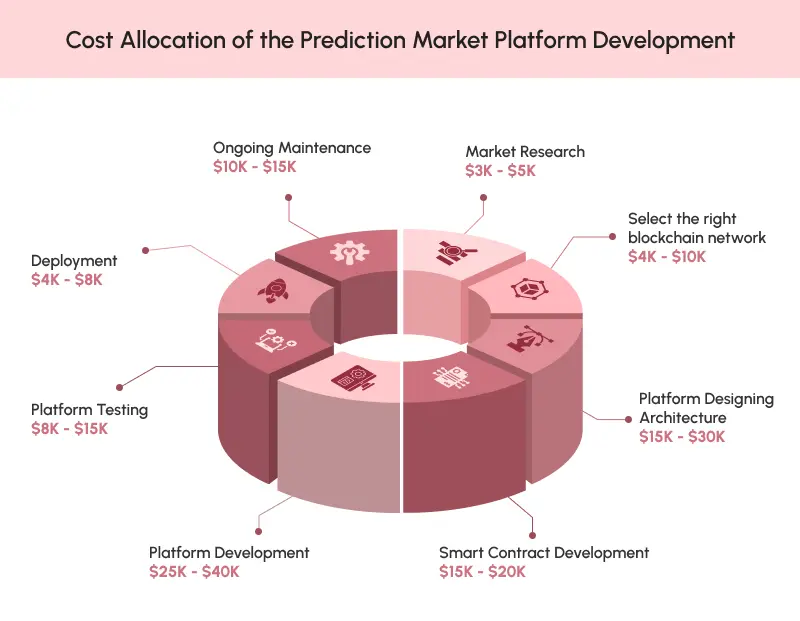
Prediction Market Platform Development follows a phase-by-phase approach, focusing on each stage carefully. By following these steps, you can effortlessly launch your own prediction market platform.
|
Phase |
Estimated Timeline | Estimated Cost |
| Market Research | 1 – 2 Weeks |
$3,000 – $5,000 |
|
Blockchain Network Selection |
1 – 2 Weeks | $4,000 – $10,000 |
| Platform Designing | 3 – 4 Weeks |
$15,000 – $30,000 |
|
Smart Contract Development |
3 – 4 Weeks | $15,000 – $20,000 |
| Platform Development | 5 – 7 Weeks |
$25,000 – $40,000 |
|
Platform Testing |
1 – 2 Weeks | $8,000 – $15,000 |
| Platform Deployment | 2 – 4 Weeks |
$25,000 to $40,000 |
|
Ongoing Maintenance |
Ongoing |
$10,000 – $15,000 |
Conduct Market Research
The prediction market platform development process should begin with complete market research. This takes a minimal investment of $3000 to $5000, which is really important to understand the market dynamics. Identifying target users, popular prediction niches, competitor platforms, and regulatory requirements are essential. Here, businesses will define what type of prediction markets they want to offer, user participation, and business model.
Selecting the Right Blockchain Network
Choosing the right blockchain network is important, as it directly influences your platform’s performance, scalability, and overall cost. With an estimated cost of $4,000 to $10,000, this phase is about analyzing and selecting the right network that fits your business model. The chosen network should be fast and efficient to place and operate predictions.
Platform Designing & Architecture
With an investment of $15,000 to $30,000, our professional design team will build a complete architecture. We take care of both User Experience (UX) and User Interface (UI) designs. We begin with detailed mockups and wireframes, present them to you for feedback, and optimize every element based on your vision. This ensures that the final design is visually appealing, while also aligning with your unique business goals.
Smart Contract Development
Smart contracts are really important in the prediction market platform development. Spending between $15,000 to $20,000 here is important given their use case. These contracts can handle market creation, bet placements, reward distribution, and many more. Besides, we also provide end-to-end auditing services to identify and fix vulnerabilities.
Platform Development
This is the most important phase, where you might spend nearly half of your cost quote, summing up around $25,000 to $40,000. Our team here will develop every aspect of the prediction market ecosystem.
From frontend interfaces, backend infrastructure, admin/user dashboards, to core functionalities, everything is planned out here. Additional features and functionalities like API integrations, third-party tools, storage modules, etc., are incorporated here.
Platform Testing
Now, upon development, we can move out to the testing phase, which can be done in a budget of $8000 to $15,000. Based on your business objective, we perform functional, security, and performance-based testing. Every feature, smart contract interaction, and user flow is tested under multiple scenarios to eliminate bugs and vulnerabilities.
Platform Deployment
Once the testing is done, our team will handle the deployment process within a cost range of $4,000 to $8,000. In this phase, you would deploy the platform to the mainnet by launching your platform in a live environment. Ensuring CI/CD pipelines, domain setup, and security configurations are important for a smooth and secure launch.
Ongoing Maintenance
After launch, maintaining and upgrading your platform is also equally important. With an annual investment of $10,000 to $15,000, we provide continuous support to keep your platform running. Regular updates, bug fixes, smart contract upgrades, security patches, and performance optimization are also equally important.
Find the Right Development Approach for Your Platform
From core features to the right tech stack, every decision impacts your platform’s performance and scalability. Connect with experts to plan the ideal architecture and development approach tailored to your goals.
Revenue Models of Prediction Market Platform Development
A prediction market platform development offers multiple streams of revenue. These platforms allow businesses to earn consistently,
Ads and Sponsorships – Upon gaining user traction and daily activity, their value increases. Brands can promote their products or services, display ads, and partner with sponsors to generate steady income.
Trading Fee – Every time a user places a trade or participates in a prediction, the platform charges a small percentage as a transaction fee.
Market Creation Fee – This is a unique way to make money. The users or organizations who want to create new prediction markets for sports, finance, or real-world events are charged a fee.
Withdrawal and Deposit Fees – The users are charged a small fee when adding funds to or withdrawing funds from the platform.
Spread or margin Fee – The platform creates a price difference between buying and selling positions, allowing you to earn a profit from each trade.
Why Choosing Pixel Web Solutions for Prediction Market Platform Development is the smartest choice?
When it comes to building a reliable and scalable prediction market platform, choosing the right development partner is important. This is where Pixel Web Solutions comes into the picture. With over 12+ years of industry experience and a proven track record of delivering 560+ successful projects, we offer exemplary technical solutions. We create performance-based ecosystems tailored to your business goals. Our team understands the complexities involved in prediction market development. From trading engine architecture to smart contract automation, we integrate every essential component into your platform.
At Pixel Web Solutions, we provide end-to-end prediction market development services tailored to different business needs. Such as,
- Custom Prediction Market Platform Development – We tailor platforms completely from scratch to match your unique business model, feature requirements, and scalability goals.
- Prediction Market DApp Development – Develop decentralized applications (DApps) that operate on blockchain networks, offering enhanced security and user control.
- API & Third-Party Integrations – Integration of external services like data oracles, payment gateways, analytics tools, and more for enhanced functionality.
- Maintenance & Support Services – Besides, we offer ongoing technical support, platform upgrades, performance monitoring, and bug fixes to ensure smooth operations post-launch.
Let’s Wrap Up
To conclude, prediction market platform development is quickly gaining momentum as businesses recognize its potential. These systems combine user engagement, data intelligence, and revenue generation into one ecosystem. Earlier, this was just a niche concept, but now evolving into a mainstream opportunity. From understanding the cost factors to choosing the right development approach, a successful prediction market platform requires both strategic planning and a technical foundation. So, businesses that invest in the right features, scalable architecture, and a reliable development partner can position themselves ahead of the curve.
FAQ – Frequently Asked Questions
- What is a prediction market platform?
A prediction market platform is a system where users can place bets on the outcome of events. From sports and politics to finance and real-world scenarios, these platforms focus on various sectors. The platform aggregates these predictions to generate real-time probabilities.
- How long does it take to develop a prediction market platform?
The time taken to develop a prediction market platform can be determined based on your chosen development approach and various influential factors.
- Can prediction market platforms generate revenue?
Yes. They can make money through trading fees, market creation fees, ads/sponsorships, withdrawal/deposit fees, and spreads or margin fees.
- Which blockchain is best for prediction market development?
It depends on your platform and business requirements. However, it is best to choose a high-performing, low-fee, and scalable blockchain network.
Ready to Build Your Prediction Market Platform?
Take the next step toward launching a scalable and secure platform. Connect with our team to turn your idea into a real product.