






Table of Contents
Last updated: 9 October 2026 | Reviewed by Mathibharathi Mariselvan, Co-founder, Pixel Web Solutions | 12 min read
Here is how to create a DeFi app MVP in 2026: pick one core function such as swaps, lending or staking, build it on audited contract patterns, test it on a public testnet, get an independent audit, and launch on mainnet with deposit caps while you collect real user data. A focused DeFi MVP on proven patterns typically costs $5,000 to $15,000 and takes 3 weeks to 2 months; Pixel Web Solutions' DeFi protocol development starts at $6,000.
DeFi has moved past the hype cycle. According to DefiLlama, decentralised finance held about $91.6 billion in total value locked on 9 October 2026, down from about $169 billion a year earlier. The money that stayed is concentrated in a few trusted protocols, so new apps must prove safety and real demand before they ask users for deposits.
That is exactly why the MVP (Minimum Viable Product) approach matters. Startups use an MVP to test their product, user expectations and real-world feedback without betting the whole budget on version one. This guide shows how to create a DeFi app step by step, what to build versus fork, and how to launch without becoming the next exploit headline.
Key Takeaways
- Start with one function: a swap, a single lending market or a staking vault is enough to validate demand; everything else waits for version two.
- Fork or reuse audited patterns where licences allow: some leading codebases, such as Aave v3, use a Business Source License, so check terms before you copy.
- Security is the biggest risk: crypto projects lost about $972 million across 207 hacks in the first half of 2026, and key compromise and privileged access caused much of the damage.
- Launch with guardrails: deposit caps, a multisig with a timelock and a pause function protect early users while you learn.
- Check regulation by market: the UAE's new Central Bank Law now reaches activity carried out "through any technology", and MiCA only exempts fully decentralised services.
A Quick Glance at a DeFi App MVP
An MVP, or Minimum Viable Product, is a simplified but working version of the full DeFi app. It ships a clean UI/UX, the essential features and real security mechanisms, then goes to market so you can measure results. Through a DeFi MVP, a startup can check its business case within weeks and upgrade the full app based on evidence.
An MVP usually launches to a limited group of users, which helps startups gather feedback while keeping funds at risk small. Does creating a DeFi app MVP strain a startup budget? Not if the scope stays tight and the team reuses audited building blocks.
How to Create a DeFi App MVP?
An MVP helps validate DeFi business ideas, but it still needs skilled developers who understand smart contract security. Research your development partner carefully to avoid technical failures. Here are the seven steps.
Step 1: Define the Scope of the DeFi App MVP
Before development, be clear about the vision, target users and the single problem you solve. This helps you find competitors, shape strategy and choose functions. Conduct market research and competitor analysis to build the roadmap, and decide whether the app is primarily for lending, staking or swapping.
Write the scope as one sentence a user would understand, for example: "Deposit USDC, earn the lending rate, withdraw any time." That sentence then drives UI/UX design, core functions and security features. A tight roadmap avoids technical debt and wasted budget.
Step 2: Choice of Blockchain and Tech Stack
DeFi users expect speed, low fees and wallet support, so the tech stack matters. The blockchain choice affects gas fees, scalability, transaction speed and how many users you can reach. As of 9 October 2026, DefiLlama shows Ethereum holding about $51.4 billion of DeFi value, with Solana and Base at about $6.2 billion each and BNB Chain at about $5.6 billion. Many teams launch on an Ethereum layer 2 for low fees while keeping access to Ethereum's liquidity.
A typical 2026 DeFi MVP stack looks like this:
- Front end: React.js or Next.js for web, and React Native for mobile apps.
- Wallet connection: wagmi and viem, WalletConnect for mobile wallets, and optionally smart accounts under ERC-4337 account abstraction for gasless onboarding.
- Back end and data: Node.js services plus an indexer, such as a subgraph, to read on-chain events quickly.
- Oracles: a price feed network such as Chainlink for any app that values collateral.
Step 3: Smart Contract Development
Smart contracts are self-executing programs that enforce predefined conditions without third-party approval. In a DeFi app MVP they hold user funds, so they decide security, scalability and reliability. The code varies by app type, so work with experienced DeFi developers.
- Development frameworks: Hardhat and Foundry are the standard tools for writing, compiling and testing contracts. Truffle, often listed in older guides, was sunset by Consensys in 2023.
- Languages: Solidity for Ethereum and EVM chains, and Rust for Solana.
- Core functions: only the ones your MVP needs, such as token swapping, a single lending market or a staking vault.
Add the necessary security protocols at this stage, not later. Every privileged function, such as pausing, upgrading or changing fees, should sit behind a multisig wallet with a timelock.
Step 4: Testing
Once DeFi smart contract development is complete, run a full quality assurance cycle. Smart contracts are hard to change once deployed, so a single error can lock or leak funds. Quality checks keep transactions running smoothly.
- Unit testing: confirms each smart contract function works as intended.
- Fuzz and invariant testing: throws thousands of random inputs at contracts to find edge cases, a built-in feature of Foundry.
- Back-end testing: checks data consistency and security in off-chain services.
- Penetration testing: ethical hackers probe the app, APIs and admin panels for weaknesses.
- Testnet deployment: run the full app on a public testnet, such as Ethereum's Sepolia, with real users before touching mainnet.
Thorough testing ensures your DeFi MVP is secure, stable and ready for crypto users.
Step 5: Audit and Guarded MVP Launch
Older guides put the audit after launch. In 2026, that order is a costly mistake. Get an independent audit through smart contract audit services before mainnet, fix every critical finding, and publish the report so users can check it.
Then launch on mainnet with guardrails:
- Deposit caps: limit total value locked, and each wallet's deposit, for the first weeks.
- Allowlist or invite codes: start with early adopters who give feedback.
- Monitoring and alerts: watch contract events and admin actions in real time.
- Bug bounty: reward researchers who report flaws privately.
Track user engagement and behaviour from day one, because that data decides whether the MVP succeeds.
Step 6: Measure, Iterate and Re-audit
After launch, regular reviews keep the MVP DeFi app performing well. Stress test the system under heavy load and market swings to reduce vulnerabilities, and roll out essential feature updates for higher engagement. Every contract change needs a fresh review or audit before deployment.
Measure the numbers that matter: weekly active wallets, deposits retained after 30 days, transaction volume and the share of users who return. These metrics tell you which add-on features deserve budget.
Step 7: Full DeFi App Launch
With market research, user metrics and a proven core, you can scale the DeFi application with additional features. Raise deposit caps in stages, add chains or markets, and keep auditing each release. Plan continuous updates based on user feedback and leading DeFi industry trends.
These are the steps to create a DeFi app MVP. By following them, startups reduce risk and reach the market faster. Next, let's decide what to build yourself and what to reuse.
Build, Fork or Integrate: Scoping Your DeFi MVP by App Type
Most guides stop at "define your features". Yet knowing how to create a DeFi app well means deciding which parts to write from scratch. Reusing audited code cuts cost and risk, but licences and security still need checking. This framework shows a sensible MVP scope for each common app type.
| DeFi app type | Minimum contract set for an MVP | Build, fork or integrate? | Main risk to design for |
|---|---|---|---|
| Swap or DEX | Pool, router and LP token | Build on an established AMM design, or integrate an aggregator API if you only need a swap front end | Price manipulation and low liquidity |
| Lending and borrowing | One market, interest rate model, oracle adapter, liquidation logic | Fork only where the licence allows; Aave v3 code uses a Business Source License with conditions | Oracle failure and bad debt |
| Staking or yield vault | Vault contract with a standard share token (ERC-4626) and a strategy | Build from audited vault libraries | Strategy losses and withdrawal queues |
| DeFi wallet | No custom contracts required at MVP stage | Integrate wallet SDKs and protocol APIs | Key management and phishing |
| Stablecoin or synthetic asset | Mint, burn, collateral and oracle modules | Custom build with strong legal review | Peg failure and regulation |
Two rules apply to every row. First, never fork code you have not read: copied bugs are still your bugs. Second, check the licence before you deploy, because some licences restrict commercial forks for a set period.
Common Mistakes That Sink DeFi MVPs
Security failures, not missing features, end most early DeFi projects. Crypto projects lost about $972 million across 207 hack incidents in the first half of 2026, the highest incident count on record, according to Immunefi data reported by The Block. Much of the damage came from private key compromises, cross-chain configuration errors and weak privileged access.
Avoid these mistakes:
- Single-key admin control: one compromised laptop can drain the protocol. Use a multisig and a timelock.
- Launching unaudited "just for testing": mainnet is never a test. Use caps and an audit, or stay on testnet.
- Thin oracle design: pricing collateral from one low-liquidity pool invites manipulation.
- Too many features: every extra contract adds attack surface and audit cost.
- Ignoring regulation: front ends that offer lending or derivatives to the public can trigger licensing duties.
Regulatory Checkpoints for a DeFi App in 2026
Regulation now reaches DeFi in several major markets. Check these before launch:
- United Arab Emirates: Federal Decree-Law No. 6 of 2025, the new UAE Central Bank Law, extends licensing to anyone who carries on or facilitates a licensed financial activity "through any means, medium, or technology", which law firms read as reaching DeFi front ends and protocols. Its one-year transition ended in September 2026. Dubai's VARA and ADGM's FSRA also license virtual asset activity in their zones.
- European Union: MiCA applies to crypto service providers, but it does not cover services provided in a fully decentralised way without an intermediary. Most MVPs with an admin team do not meet that test.
- United States: regulators treat lending, leverage and derivatives seriously. In 2023 a federal court held that the Ooki DAO was a "person" liable under commodities law in a CFTC enforcement action.
Get legal advice for each market before you accept public deposits.
Lucrative Business Perks of Creating a DeFi App
Apart from real-world feedback, a DeFi app MVP gives startups several business advantages.
Quick Development
A focused DeFi MVP on proven patterns can launch in 3 weeks to 2 months. This helps businesses reach early adopters before the market shifts.
Better Personalisation
A DeFi app gives startups direct feedback from crypto users, so they can add features and scale based on actual needs, preferences and on-chain behaviour instead of assumptions.
Brand Presence
A live, audited DeFi app builds credibility with users worldwide. Because DeFi is open by default, startups can reach a global audience and build brand identity, subject to the regulatory checks above.
Cost-Effective Solution
An MVP lets startups test market viability at a lower cost and reduces financial risk. It also surfaces flaws and user preferences early, which prevents costly redesigns later.
With these perks, a DeFi app MVP is a strong stepping stone into the DeFi market. To make it work, you need the right features.
Essential Features to Integrate While Creating a DeFi App
Features decide whether the DeFi app works smoothly for its first users. Integrate only the essential ones in the MVP, then gather real-world feedback.
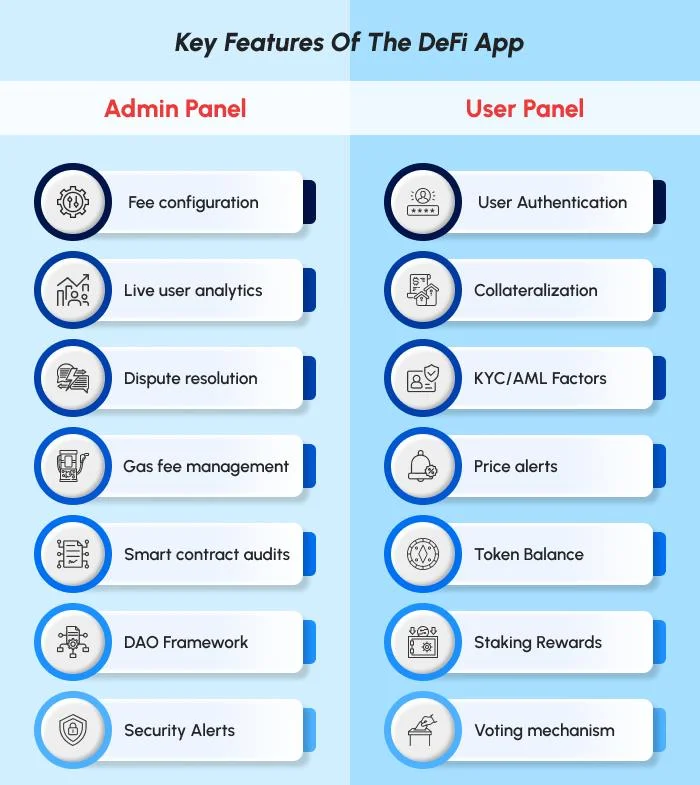
The DeFi app MVP should ship minimal but essential features, with the focus on security and quality: wallet connection, the core transaction flow, clear fee and risk disclosures, a transaction history and an admin dashboard behind a multisig. Many teams also offer a companion wallet; Pixel's DeFi wallet development services start from $5,000 if you need one. After the MVP is validated, you can scale with additional features and security mechanisms.
The most frequent question startups ask next is cost, so here is the breakdown.
How Much Does It Cost to Create a DeFi App With an MVP?
The cost to create a DeFi app with an MVP depends on feature complexity, blockchain choice, the development team and security requirements. Here are typical ranges, consistent with Pixel's full cost guide:
| Build level | Typical scope | Timeframe | Estimated cost |
|---|---|---|---|
| Focused MVP on proven patterns | One core function, such as swaps, staking or a single lending market | 3 weeks to 2 months | $5,000 to $15,000 |
| Mid-level DeFi app | Several features, polished UI, admin panel and integrations | 2 to 4 months | $15,000 to $55,000 |
| Full-scale protocol | New mechanisms, governance, multi-chain support | 4 to 9 months or more | $55,000 to $150,000+ |
Pixel Web Solutions' published prices start at $6,000 for DeFi protocol development, $7,500 for a standard AMM DEX and $5,000 to $25,000 for DeFi lending. If a DEX is your core function, Pixel's decentralized exchange development team handles it. Budget separately for audits, liquidity incentives and ongoing maintenance.
For more details, read our related article:
How much does it cost to create a DeFi app?
Choose a reputable DeFi development company like Pixel Web Solutions, with skilled smart contract developers, security reviewers and product specialists.
Frequently Asked Questions
How long does it take to create a DeFi app MVP?
A focused DeFi MVP built on proven contract patterns typically takes 3 weeks to 2 months, plus time for an independent audit. Apps with new mechanisms or several features take 2 to 9 months.
Can I create a DeFi app without coding?
You can launch simple token or front-end projects with no-code tools, but any app that holds user funds needs reviewed smart contracts. For anything beyond a demo, work with experienced developers and get an audit.
Which blockchain is best for a DeFi app?
Ethereum holds the most DeFi value, about $51.4 billion on 9 October 2026 according to DefiLlama. Layer 2 networks such as Base and Arbitrum offer lower fees with Ethereum compatibility, while Solana suits high-speed apps written in Rust.
Do I need an audit for a DeFi MVP?
Yes, if real funds are involved. Audit before mainnet, not after, and launch with deposit caps so any undiscovered bug has limited impact.
Is it legal to launch a DeFi app?
It depends on where you operate and what the app does. The UAE, the EU and the US all apply licensing rules to some DeFi activity, especially lending, derivatives and fiat on-ramps. Take legal advice for each target market.
How do DeFi apps make money?
Common models include swap fees, a share of lending interest, performance fees on vaults and premium features. Choose a model that works at small scale, because MVP volumes are low.
Power Your DeFi App MVP Success With Pixel Web Solutions!
Create a secure, high-performing DeFi app MVP with Pixel Web Solutions' experienced developers, without compromising on quality. The team specialises in DeFi MVPs built on audited patterns, with multisig admin controls, guarded launches and an advanced tech stack.
Pixel's expertise in blockchain development, smart contracts and user-centric design helps your DeFi app launch safely and scale with confidence. Ready to learn how to create a DeFi app with an expert team? Explore Pixel's DeFi development services or contact the team for a scoped quote.