Table of Contents
Last updated: 22 September 2026 | Reviewed by Mathibharathi Mariselvan, Co-founder, Pixel Web Solutions | 11 min read
The main benefits of starting a crypto exchange are recurring revenue from trading fees and many other streams, a global customer base, a brand at the centre of the crypto economy, room to build an ecosystem of wallets, cards and payments, and the option to launch on white-label software from about $25,000. Coinbase alone earned $1.2 billion in the second quarter of 2026. The trade-offs are licensing, liquidity, security and compliance costs, which every serious exchange plan must budget for.
The crypto market keeps expanding: total market capitalisation was $2.89 trillion on 24 September 2026, according to CoinGecko, and stablecoin supply reached $311 billion. Every one of those assets needs a trusted place to be bought, sold, converted and stored, and that is the job of a crypto exchange.
This article sets out the 10 business benefits that make crypto exchange development attractive, the benefits of crypto trading that bring users to exchanges, the challenges to plan for and how to get started. Before you commit, pair it with a solid crypto exchange business plan.
Key Takeaways
- Revenue is recurring and diversified: trading fees, spreads, listings, staking, subscriptions, cards and stablecoin interest.
- The market is global and 24/7, so an exchange can serve users across time zones from day one.
- White-label software lowers the entry cost to about $25,000 to $50,000 for the platform.
- Licensing, liquidity and security decide success, and they cost as much attention as the software.
- Users come for the benefits of crypto trading: round-the-clock markets, low minimums, fast settlement and access to new assets.
Top 10 Benefits of Cryptocurrency Exchange Development
Here are the 10 advantages that make creating a crypto exchange a strong business strategy:
- High revenue potential
- Access to the global market
- A business built for the future of finance
- Establish your brand
- Start with a limited budget using white-label software
- Collaborations and partnerships
- Ongoing market demand
- Build your own ecosystem
- Security and trust as a competitive edge
- Diversified revenue streams
High Revenue Potential
A crypto exchange earns every time users trade, and it can add many other revenue streams:
- Trading fees: a percentage of each trade, usually through a maker-taker fee model.
- Spreads: a margin built into instant buy, sell and convert prices.
- Listing fees: charged to projects listing their tokens.
- Deposit and withdrawal fees: covering network and payment costs plus a margin.
- Staking commissions: a share of staking rewards earned for users.
- Subscriptions: lower fees, higher limits or premium tools for a monthly price.
- API fees: premium API tiers for algorithmic traders.
- Crypto cards: interchange and issuance fees.
- Lending and margin: interest on loans to traders.
- Stablecoin interest: a share of the interest on stablecoin balances held on the platform.
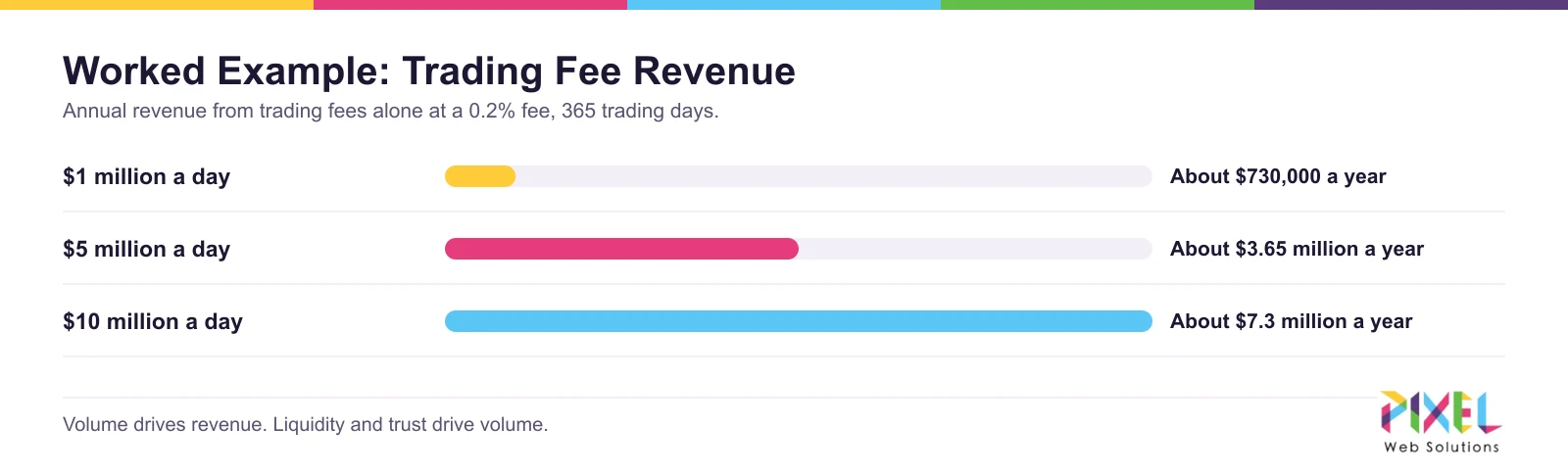
The scale can be significant. Coinbase earned $599 million from transactions and $555 million from subscriptions and services in Q2 2026 (CNBC). A smaller exchange trading $1 million a day at a 0.2% fee earns about $730,000 a year from trading fees alone. Read more on how crypto exchanges make money.
Access to the Global Market
Crypto trades 24/7 across borders. An exchange can serve users in many countries with local currency pairs, local payment methods and multilingual support, as long as it holds the right licences for each market.
A Business Built for the Future of Finance
Stablecoins, tokenized assets and crypto payments are moving into mainstream finance, with clearer rules such as the EU's MiCA framework and the US GENIUS Act for stablecoins. Exchanges sit at the centre of that shift as the on-ramp, marketplace and custodian for digital assets.
Establish Your Brand
Owning an exchange lets you build a trusted financial brand: your design, your products, your community and your customer relationships. Trust built through transparency, security and service becomes a lasting competitive advantage.
Start With a Limited Budget Using White-Label Software
You do not need to build from scratch. A white-label crypto exchange costs about $25,000 to $50,000 and can launch in 8 to 12 weeks, compared with $100,000 to $150,000 or more for a custom build. Licensing, liquidity and marketing still need a budget, so plan the whole picture with our guide to the cost to build a crypto exchange.
Collaborations and Partnerships
Exchanges partner with token projects, payment providers, wallets, market makers, media and fintechs. Listings, co-marketing and integrations bring users and volume, and B2B partnerships such as white-label or API services add revenue.
Ongoing Market Demand
New assets, new users and new use cases keep arriving: stablecoins for payments, tokenized funds, and regional users who want local currency pairs. Exchanges that list responsibly and serve a specific market well keep finding demand.
Build Your Own Ecosystem
An exchange can grow into an ecosystem: a branded wallet, a crypto payment gateway, a launchpad, cards, staking and an NFT or tokenization marketplace. Each product increases engagement and revenue per user.
Security and Trust as a Competitive Edge
Users choose exchanges they trust. Cold storage, MPC custody, multi-factor authentication, withdrawal whitelists and proof of reserves are not just protections; they are selling points. Our guide to crypto exchange security explains the essentials.
Diversified Revenue Streams
Unlike businesses with one income source, an exchange earns from trading, services, staking, listings and partnerships. Coinbase's subscription and services revenue reached a record 48% of net revenue in Q2 2026, which shows how diversification protects exchanges when trading slows.
Benefits of Crypto Trading: Why Users Come to Exchanges
Understanding what traders value helps you design an exchange they choose:
- 24/7 markets: crypto trades around the clock, including weekends and holidays.
- Accessibility: users can start with small amounts, often a few dollars.
- Fast settlement: trades and stablecoin transfers settle in minutes, not days.
- Access to new assets: from Bitcoin and stablecoins to tokenized assets and new projects.
- Portfolio diversification: crypto adds a distinct asset class alongside stocks and bonds.
- Transparency: blockchain transactions can be verified publicly.
- Mobile-first trading: full trading, wallets and alerts in one app.
Crypto trading also carries real risks, including high volatility and the possibility of losses, so responsible exchanges provide clear risk warnings, education and tools such as stop-loss orders.
Advantages of a Dedicated Crypto Exchange App
Most retail traders now use mobile apps. A dedicated app offers biometric login, instant price alerts, one-tap trading and full account security on the go, which increases engagement and trading frequency compared with a browser-only exchange.
Why Many Founders Build an Exchange Like Binance or Coinbase
- A Coinbase-style exchange focuses on simple buying, regulated markets and trust, ideal for a licensed brokerage in one country. See our Coinbase clone script.
- A Binance-style exchange focuses on deep order books, many pairs and derivatives for active traders. See our Binance clone script.
Challenges to Plan For
A balanced plan also accounts for the hard parts:
- Licensing: most markets require a licence, which sets your launch date and a large part of the budget.
- Liquidity: an empty order book drives users away, so market makers and liquidity providers are essential.
- Banking: fiat deposits and withdrawals depend on payment and banking partners.
- Security: exchanges are prime targets for attackers; custody and monitoring must be strong.
- Competition: large global exchanges dominate, so success usually comes from a specific region, asset class or user group.
Our guide on how to start a cryptocurrency exchange walks through each step.
Final Thoughts
Starting a crypto exchange offers recurring, diversified revenue, a global market and the chance to build a trusted brand at the centre of digital finance. The opportunity is real, and so are the requirements: licensing, liquidity, security and a clear niche.
If these benefits fit your plans, Pixel Web Solutions can help. As a provider of crypto exchange development services since 2012, we build white-label and custom exchanges and support you from planning to launch. Talk to our team today.
Frequently Asked Questions
What are the benefits of starting a crypto exchange?
Recurring revenue from trading fees and many other streams, a global 24/7 market, a trusted brand in digital finance, the ability to build an ecosystem of related products and a lower entry cost through white-label software.
Is starting a crypto exchange profitable?
It can be. Revenue scales with trading volume and added services, but licensing, liquidity, security and marketing costs are significant, so profitability depends on reaching enough volume in a clear niche.
How much does it cost to start a crypto exchange?
A white-label exchange costs about $25,000 to $50,000 to build, and a custom exchange $100,000 to $150,000 or more. Licensing, liquidity, team and marketing add to the first-year budget.
What are the main benefits of cryptocurrency trading?
Round-the-clock markets, low minimum investments, fast settlement, access to new assets, portfolio diversification and transparent transactions, balanced against high volatility and the risk of loss.
Do I need a licence to start a crypto exchange?
In most countries, yes. Examples include FinCEN registration and state licences in the US, a MiCA licence in the EU, VARA in Dubai and FIU-IND registration in India.
How long does it take to launch a crypto exchange?
A white-label exchange can be ready in 8 to 12 weeks, but licensing often takes longer, so start the licence application early.