Table of Contents
Last updated: 17 September 2026 | Reviewed by Mathibharathi Mariselvan, Co-founder, Pixel Web Solutions | 13 min read
The NFT businesses still making money in 2026 are the ones built on utility: tokenized physical collectibles, platform-native digital items, ticketing and loyalty, gaming items, niche marketplaces, NFT wallets and minting tools for brands. On-chain data shows the shift clearly: in the 30 days to 24 September 2026, Telegram's Fragment marketplace earned $29.8 million in fees and tokenized trading-card platform Collector Crypt $10.5 million, while OpenSea's Seaport protocol earned $3.3 million, according to DefiLlama. An NFT business can start from $5,000 for a minting project and $20,000 to $60,000 for a marketplace MVP.
NFTs (non-fungible tokens) went from pixelated art to a multi-billion-dollar trading craze, then crashed. Several big platforms, including Nifty Gateway, Foundation and Binance NFT, closed in 2026, and brands such as Nike and Starbucks shut their NFT programmes. So is an NFT business still worth starting?
Yes, if you build for a real use rather than speculation. This guide covers the seven NFT business ideas with genuine demand in 2026, how NFT businesses make money, how brands use NFTs, how to write an NFT business plan and what each idea costs to launch.
Key Takeaways
- Speculative NFT trading has shrunk; utility NFTs are growing. Tokenized trading cards, Telegram collectibles, tickets and gaming items now drive most NFT revenue.
- General-purpose NFT marketplaces are a crowded, shrinking field. Niche marketplaces with a specific community or asset type still work.
- NFT business models rely on transaction fees, minting fees, subscriptions, in-app purchases and redemption fees for physical items.
- Brands use NFTs for loyalty, ticketing and authenticity, but programmes fail when the NFT adds no value customers care about.
- Costs start at about $5,000 for an NFT collection with minting, $20,000 to $60,000 for a marketplace MVP and $45,000 to $150,000 for a fully custom marketplace.
How Can Investing in NFT Business Ideas Lead to Big Wins?
An NFT business wins when the token solves a real problem: proving ownership, preventing counterfeits, enabling resale or connecting a digital item to a physical one. Here is what a well-chosen NFT business offers.
Potential Revenue Streams
NFT platforms earn from transaction fees, minting fees, subscriptions, in-app purchases and redemption or vaulting fees for physical items. Diversifying across these streams makes the business less dependent on trading volume.
Global Outreach
An NFT can be bought, sold and verified anywhere in the world, 24/7. That lets a small team reach collectors, gamers and fans across borders without local distribution.
Speed to Market
A white-label NFT marketplace or minting platform can launch in weeks rather than months. Pixel's NFT marketplace builds typically take 15 to 20 business days for a standard platform, so you can test demand quickly.
Cost-Effective Entry
Compared with exchanges or lending platforms, many NFT businesses need no financial licence and can start small. A white-label NFT marketplace keeps launch costs low while you prove your niche.
The honest caveat: NFT prices are volatile, most collections lose value, and a platform without a loyal community will struggle. Choose ideas where the NFT does something useful, not ideas that depend on prices rising.
Top 7 NFT Business Ideas To Know In 2026
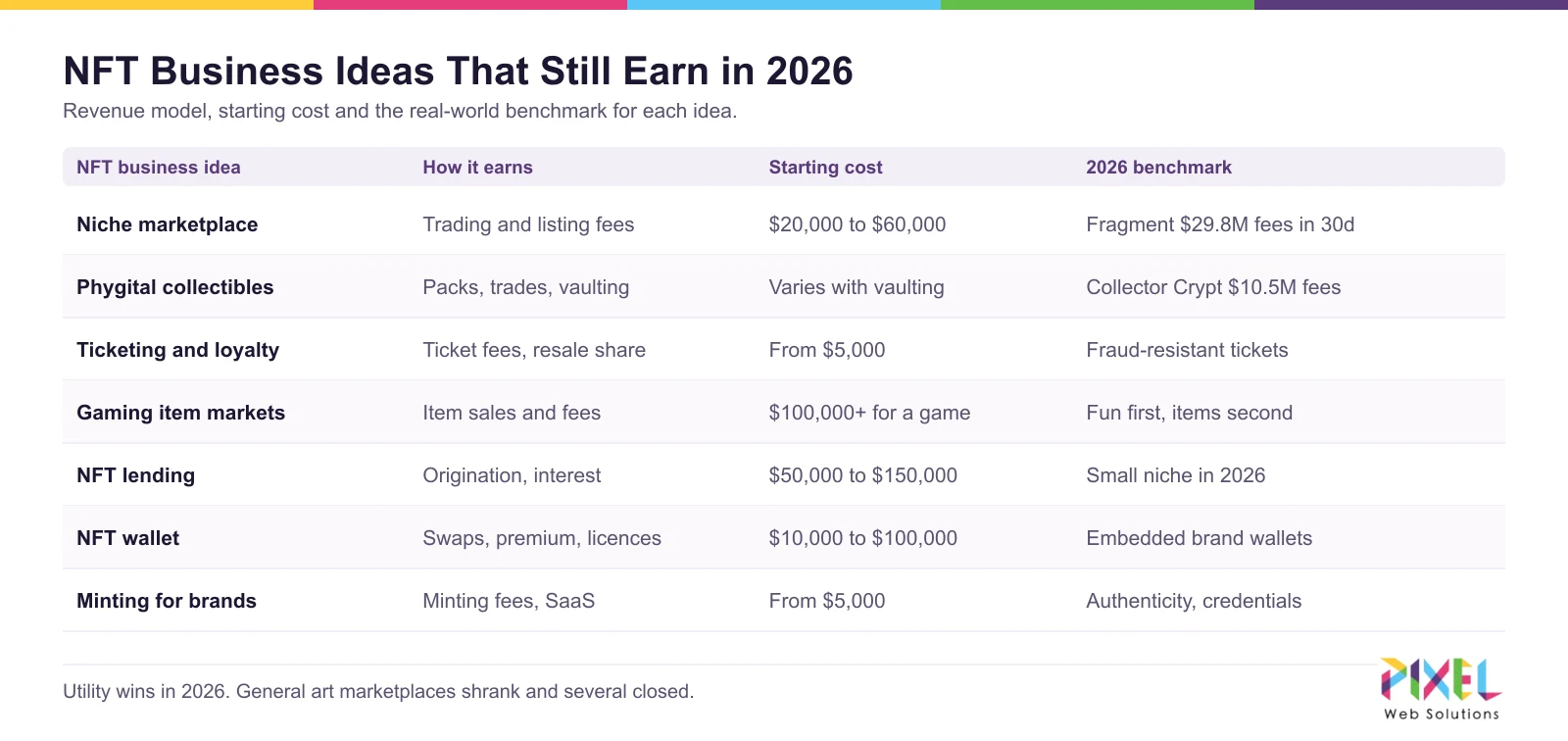
Here are the seven NFT business ideas with real demand in 2026, with the benchmark, revenue model and starting cost for each.
1. Niche NFT Marketplace Development
An NFT marketplace lets users mint, list, buy and sell NFTs. The general-purpose marketplace era is over: OpenSea's Seaport protocol earned $3.3 million in fees in 30 days, while specialist platforms did far better. Telegram's Fragment marketplace, which sells usernames, anonymous numbers and collectible gifts on the TON blockchain, earned $29.8 million in the same period.
The lesson: build a marketplace for a specific community or asset type, such as music, event tickets, in-game items, sports memorabilia or a platform's own digital items.
- Revenue: transaction fees, listing fees, featured placements and launch services for creators.
- Starting cost: $20,000 to $60,000 for a white-label MVP, and $45,000 to $150,000 for a fully custom build. See how to create an NFT marketplace and our NFT music marketplace development service for a niche example.
2. Phygital Collectibles and Tokenized Trading Cards
"Phygital" platforms store a physical item, such as a graded trading card, in a secure vault and issue an NFT that represents it. Owners can trade the NFT instantly and redeem the physical item whenever they want. This is the fastest-growing NFT business of 2026: Collector Crypt earned $10.5 million in fees in 30 days and Courtyard $2.2 million, according to DefiLlama.
- Revenue: primary sales (including randomized "packs"), trading fees, vaulting and redemption fees.
- What you need: a vaulting and grading partner, insurance, authentication processes and a marketplace.
- Watch out for: randomized pack sales can fall under gambling rules in some countries. Take legal advice.
3. NFT Ticketing, Membership and Loyalty Platforms
NFT tickets reduce fraud because each ticket is unique and verifiable, and organizers can earn a share of every resale. Membership passes and loyalty tokens give holders access, perks or discounts. Most users never need to know they hold an NFT if the wallet is built into the app.
- Revenue: ticketing fees, resale royalties, SaaS subscriptions for organizers and brands.
- Lesson from failures: Starbucks closed its Odyssey NFT loyalty programme in March 2024, and Nike shut down its NFT studio RTFKT in January 2025. Programmes fail when collecting NFTs becomes the point instead of a better experience.
- Starting cost: from $5,000 for a minting and verification module, more for full ticketing platforms.
4. NFT Gaming Platforms and In-Game Item Markets
Blockchain games let players truly own items (skins, weapons, characters) and trade them. The play-to-earn boom collapsed after 2022 because rewards relied on new players buying in, and Axie Infinity also lost about $600 million in the Ronin bridge hack. Games that succeed now are fun first and use NFTs for item ownership and trading.
- Revenue: in-game purchases, marketplace fees on item trades and game sales.
- Where to compete: item marketplaces for existing games, tools for studios adding NFT items, or small games with strong communities.
- Starting cost: $100,000 or more for a playable game. Item marketplaces cost less. See blockchain game development.
5. NFT Lending Platform
NFT lending lets holders borrow crypto against valuable NFTs, either peer-to-peer or from shared pools. It is a small niche in 2026: Gondi, one of the active lending protocols, generated about $230,000 in fees in 30 days, and BendDAO went through a liquidity crisis in 2023 when NFT prices fell.
- Revenue: origination fees and a share of interest.
- Where it works: high-value collectibles, tokenized physical items (trading cards, watches) and in-game assets with stable prices.
- Starting cost: $50,000 to $150,000. See NFT lending platform development.
6. NFT Wallet Creation
NFT wallets store, display and trade NFTs, and increasingly hide blockchain complexity from mainstream users. Brands and games often need their own embedded wallets so customers can hold tickets, items or loyalty tokens without installing anything new.
- Revenue: swap and marketplace fees, premium features, white-label licences for brands.
- Starting cost: $10,000 to $100,000 depending on chains and features. See NFT wallet development.
7. NFT Minting Platforms and NFT-as-a-Service for Brands
Minting platforms turn art, music, tickets, certificates and product records into NFTs. The strongest opportunity in 2026 is business-to-business: tools that let brands, event organizers and creators mint, distribute and verify NFTs without blockchain skills.
- Revenue: minting fees, SaaS subscriptions and API usage.
- Use cases: product authenticity certificates, digital product passports, event badges, course certificates and creator drops.
- Starting cost: Pixel's NFT development starts at $5,000 for a standard collection with minting.
Our list of the best NFT marketplaces shows the competitive landscape for several of these ideas.
Lucrative Revenue streams of NFT Business ideas
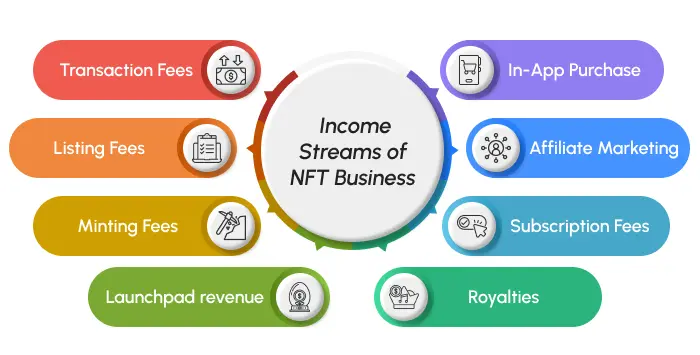
An NFT business model defines who pays and for what. These are the main revenue streams.
Transaction Fees
Marketplaces charge a percentage of each sale, typically between 0% and 2.5% in 2026, because zero-fee competitors such as Blur have pushed fees down. This remains the primary income for marketplaces and lending platforms.
Who benefits from this revenue? NFT marketplaces, lending platforms and item markets.
Listing and Featured Placement Fees
Some platforms charge to list collections or to feature them on the homepage. Listing fees also filter out spam collections.
Who benefits from this revenue? NFT marketplaces and launch platforms.
Minting Fees
Minting converts a digital file, ticket or physical item record into an NFT. Platforms charge a fee on top of blockchain gas, or a subscription for bulk minting.
Who benefits from this revenue? Minting platforms, NFT-as-a-service providers and marketplaces.
Vaulting and Redemption Fees
Phygital platforms charge to store, insure and ship the physical items behind their NFTs. This is recurring, predictable revenue that does not depend on trading volume.
Who benefits from this revenue? Tokenized collectible and luxury goods platforms.
Subscription Fees
Premium plans offer lower fees, analytics, early access to drops or bulk tools for businesses. Subscriptions smooth out the ups and downs of trading revenue.
Who benefits from this revenue? Marketplaces, minting platforms and brand tools.
Royalties and Resale Shares
Creators and organizers can earn a percentage when NFTs are resold. Many marketplaces made creator royalties optional from 2023, so platforms that enforce royalties (for example, for event tickets) can use them as a selling point.
Who benefits from this revenue? Ticketing platforms, creators and brands.
In-App Purchases
Games and apps sell items, skins and upgrades as NFTs that players can later resell.
Who benefits from this revenue? Gaming platforms and item marketplaces.
These revenue streams vary by business model, so choose the combination that fits your niche and your users' willingness to pay.
NFTs for Business: How Brands and Companies Use NFTs
Many people searching for NFT business ideas are existing businesses asking how NFTs could help them. These are the uses that deliver value:
- Tickets and access passes: fraud-resistant tickets, with the organizer earning a share of resales.
- Loyalty and membership: perks that customers can hold, trade or carry between brands.
- Product authenticity: a digital certificate for luxury goods, sneakers or collectibles that proves the item is genuine and records its ownership history.
- Warranties and product records: a transferable record of repairs, service and ownership that moves with the product when it is resold.
- Certificates and credentials: course completions, event attendance and professional certifications that anyone can verify.
What makes an NFT benefit a business? It must remove friction or add value customers notice: faster entry, easier resale, proof of authenticity or real perks. If customers need to understand wallets and gas fees, adoption will stall, so build the wallet into your app.
How to Write an NFT Business Plan
An NFT business plan should answer the same questions any investor asks, plus a few specific to NFTs.
- Problem and customer: who needs this NFT, and what does it let them do that they could not before?
- Business model: which revenue streams you will use and your expected fee levels.
- Market analysis: your niche's size, competitors and on-chain benchmarks from sources such as DefiLlama.
- Blockchain choice: Ethereum, a Layer-2 such as Base or Polygon, Solana or TON, chosen for fees, users and ecosystem.
- Legal review: intellectual property rights, consumer protection, and whether any NFTs could count as securities or gambling products.
- Go-to-market: community building, creator or brand partnerships and launch campaigns.
- Financial plan: development costs, running costs, revenue forecasts and break-even.
- Risks: market cycles, smart contract security, platform dependence and regulation.
For a detailed template that works for any crypto venture, see our crypto exchange business plan guide.
How Much Does It Cost to Start an NFT Business?
| NFT business | Typical starting cost |
|---|---|
| NFT collection with minting | From $5,000 |
| Minting platform or NFT-as-a-service tool | From $5,000, more for enterprise features |
| NFT wallet | $10,000 to $100,000 |
| NFT marketplace (white-label MVP) | $20,000 to $60,000 |
| NFT marketplace (fully custom) | $45,000 to $150,000 |
| NFT lending platform | $50,000 to $150,000 |
| NFT game | $100,000 and up |
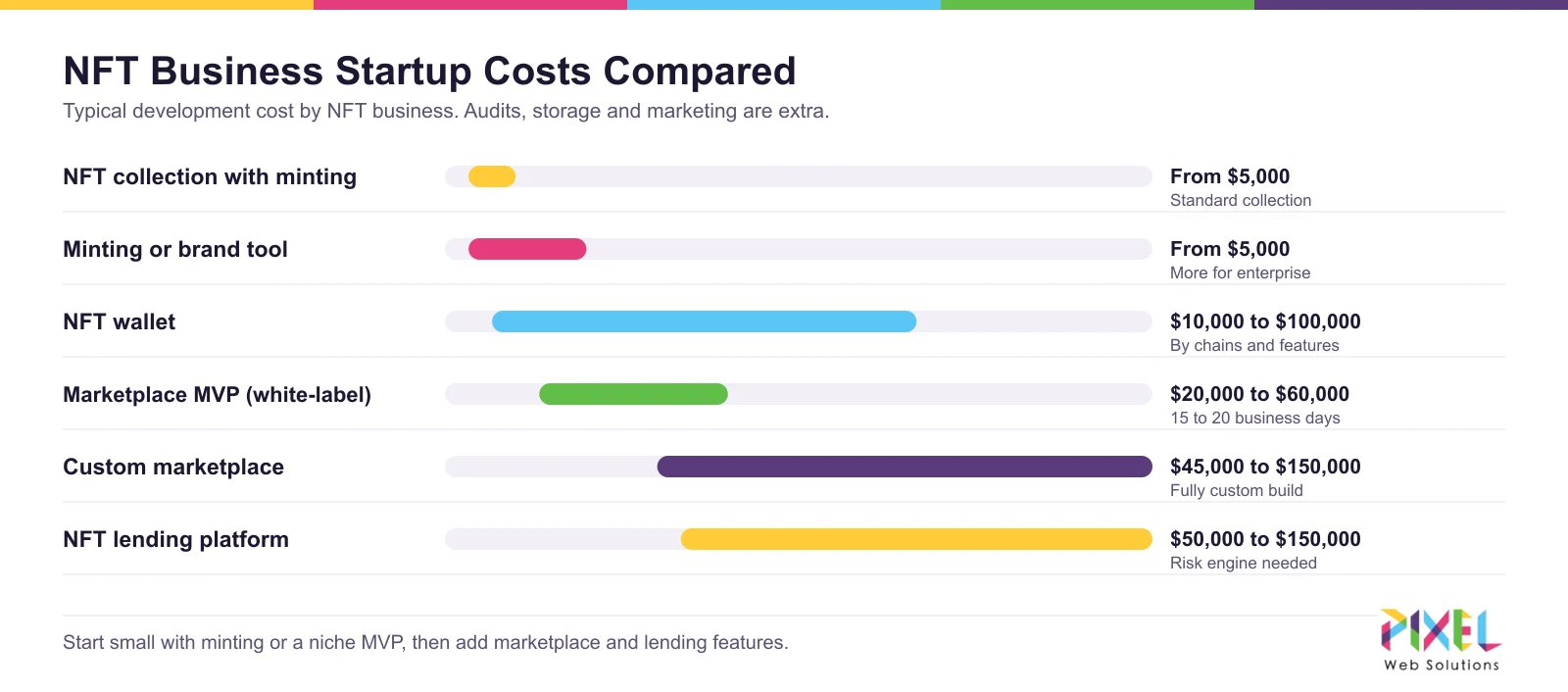
Beyond development, budget for smart contract audits, storage for media files, marketing and community management. If you are weighing NFTs against other options, our guide to cryptocurrency business ideas compares 15 alternatives.
Pixel Web Solutions – Your Gateway to Kickstart your NFT business!
Pixel Web Solutions is an NFT marketplace development company that builds marketplaces, minting platforms, wallets, lending platforms and NFT tools for brands. We help you choose a niche that has real demand, build on proven and audited contracts, and launch with the features your community needs. Explore more NFT use cases or talk to our team about your NFT business idea.
Frequently Asked Questions (FAQ)
Is an NFT business still profitable in 2026?
Yes, for utility-driven models. Tokenized collectibles, platform-native items and niche marketplaces earned millions in fees in 2026, while general art marketplaces shrank and several closed. Profitability depends on choosing a niche with real demand.
What is the best NFT business idea for beginners?
An NFT minting service or a niche marketplace built on white-label software is the most accessible, because it can launch quickly at a lower cost. Choose a community you understand, such as music, gaming or local events.
How much does it cost to create an NFT marketplace?
A white-label NFT marketplace MVP costs $20,000 to $60,000, while a fully custom marketplace costs $45,000 to $150,000. Features, blockchain choice, integrations and audits drive the final price.
What is an NFT business model?
An NFT business model is how an NFT platform earns money, usually through transaction fees, minting fees, subscriptions, royalties, in-app purchases or vaulting and redemption fees for physical items.
How can a business use NFTs?
Businesses use NFTs for tickets, loyalty programmes, product authenticity certificates, warranties and credentials. The NFT must give customers a clear benefit, and the best programmes hide the wallet and blockchain inside a familiar app.
What are the legal considerations for starting an NFT business?
Check intellectual property rights for any content you mint, consumer protection rules, tax treatment, and whether your NFTs could count as securities or as gambling products (for example, randomized packs). Rules differ by country, so take local legal advice.
Which blockchain is best for an NFT business?
Ethereum offers the most established marketplaces, Layer-2 networks such as Base and Polygon offer low fees, Solana suits high-volume collectibles and TON reaches Telegram's user base. Choose based on your audience and transaction costs.