







Fantasy sports app development cost in 2026 ranges from about $20,000 for a single-sport MVP built at offshore rates to $200,000 or more for an advanced multi-sport platform. The final figure depends on features, team location, platforms and, more than ever, the market you launch in: India banned paid fantasy contests from 1 May 2026, while most US states license or allow them.
The audience is still large. A 2025 survey by the Fantasy Sports & Gaming Association and Angus Reid Group estimated that about 57 million people in the US and Canada played fantasy sports in the previous 12 months. However, the money now flows differently by country, so your budget has to follow the law first and the feature list second.
This guide breaks the cost into hours, rates and line items, with the maths shown, so you can check every number yourself.
Key Takeaways
- Budget by tier: an MVP needs roughly 800 to 1,600 hours of work, a mid-range app 1,600 to 3,200 hours, and an advanced platform 3,200 to 8,000 hours or more.
- Rates change everything: the same 1,600-hour MVP costs about $40,000 at $25 per hour and about $160,000 at $100 per hour.
- Law sets the scope: India's Promotion and Regulation of Online Gaming Act, 2025 has banned online money games, including paid fantasy contests, since 1 May 2026, so Indian launches must be free-to-play.
- US launches carry licence and tax lines: DraftKings says its daily fantasy product runs in 44 states plus Washington, D.C., and states such as Ohio charge licence fees of up to $30,000.
- Plan for running costs: sports data feeds, cloud capacity for match-day spikes, KYC and geolocation checks, plus 15% to 20% of the build cost each year for maintenance.
How Much Does It Cost to Build a Fantasy Sports App?
The cost of creating a fantasy sports app varies with application complexity, features and the location of the development team. The ranges below are industry estimates at offshore rates of about $25 per hour, which is where most published price lists start.
- MVP: user registration, team creation, one contest type and leaderboards usually cost $20,000 to $40,000.
- Mid-range app: live scoring, a secure payment or rewards module, push notifications and better UI/UX cost $40,000 to $80,000.
- Advanced app: AI-based player suggestions, live streaming integrations, multiple sports and advanced analytics cost $80,000 to $200,000 or more.
In general, fantasy sports app development costs range from $20,000 to $200,000+, depending on customization needs. Because these numbers assume one hourly rate, the next section shows how to convert them to any team you are considering.
Worked Example: Turning Hours Into a Budget
Every quote is hours multiplied by a rate. Here is a realistic hour plan for a single-sport MVP, followed by the cost at three common rates.
| Work package | Estimated hours |
|---|---|
| Discovery, wireframes and UI/UX design | 120 to 200 |
| Cross-platform app (Flutter or React Native) | 240 to 500 |
| Backend: contests, scoring engine, user wallet or rewards | 200 to 420 |
| Sports data API integration | 60 to 120 |
| Admin panel | 60 to 120 |
| QA and testing | 70 to 140 |
| Project management and DevOps | 50 to 100 |
| Total | 800 to 1,600 |
| Hourly rate | 800 hours | 1,600 hours |
|---|---|---|
| $25 (common offshore rate) | $20,000 | $40,000 |
| $50 (mid-market rate) | $40,000 | $80,000 |
| $100 (US or Western Europe agency rate) | $80,000 | $160,000 |
The maths is simple: 800 × $25 = $20,000 and 1,600 × $100 = $160,000. For context, the US Bureau of Labor Statistics puts the median pay for software developers at $133,080 a year (May 2024), or about $64 per hour before agency overheads and margin. That is why US agency rates of $100 per hour and above are normal, and why outsourcing lowers the bill.
The same scaling applies to the larger tiers. A mid-range app at 1,600 to 3,200 hours costs $40,000 to $80,000 at $25 per hour, and an advanced platform at 3,200 to 8,000 hours costs $80,000 to $200,000 at the same rate.
Why Invest in Fantasy Sports App Development?
Fantasy sports remain a large, engaged market, although the opportunity now depends heavily on where you operate. Investing in a fantasy sports platform can still benefit startups and businesses when the model fits local law.
- A large, proven audience: about 57 million people in the US and Canada played fantasy sports in the 12 months before the 2025 FSGA survey, and 84 million played fantasy or bet on sports.
- Loyal and young players: the same FSGA study found that among 13 to 20-year-old season-long players, the average starting age is 14 and 66% update lineups daily.
- Multiple revenue streams: entry fees (where legal), advertising, sponsorships, subscriptions and in-app purchases allow diverse business models.
- High engagement and retention: users spend time every week managing teams and tracking player stats, which keeps them coming back.
- Year-round demand: apps can cover cricket, football, basketball, baseball, hockey and more, so there is always a live season.
- Future-ready with tech: AI, real-time analytics and blockchain rewards make fantasy sports more engaging and competitive.
Big operators show where the money has moved. DraftKings reported fiscal 2025 revenue of $6.05 billion, up 27%, but most of it now comes from sportsbook and iGaming rather than fantasy contests. In India, Dream11 stopped paid contests and pivoted to a free-to-play, ad-funded model after the 2025 law. If you are exploring the full step-by-step guide to building a fantasy sports app, choose the monetization model before you finalize the budget.
Factors that Affect the Fantasy Sports App Development Cost
Each factor below, from features to the location of your development team, directly moves the hour count or the rate. Here are the main drivers.
1. App Complexity
Complexity is the biggest cost driver. A simple app that lets users sign up, create teams and view scores is affordable. A mid-level app with live match tracking, in-app purchases and multi-league support costs more. High-complexity apps with AI predictions, live chat or AR need a larger team and more hours.
2. Technology Stack
Cross-platform tools like React Native or Flutter are usually cheaper than separate native apps in Swift and Kotlin. Backend choices (Node.js, Python or Go) and databases (PostgreSQL, MongoDB or Redis for live leaderboards) also affect cost. In addition, licensed APIs for live scores or payments add monthly fees.
3. Type of Sports App
A single-sport app, such as fantasy cricket or football, is simpler and cheaper. A multi-sport app needs a separate scoring ruleset, data feed and contest calendar for every sport, which raises both build and running costs.
4. Geographic Location of Developers
Developer rates vary widely by region. Teams in North America and Western Europe commonly charge $50 to $200 per hour, while skilled teams in Asia and Eastern Europe often charge $15 to $75 per hour. As the worked example shows, rate alone can multiply your budget by four.
5. App Maintenance and Updates
Budget about 15% to 20% of the original development cost each year for bug fixes, OS updates, server checks and new features. For a $60,000 build, that is $9,000 to $12,000 a year, or roughly $750 to $1,000 a month, before hosting and data fees.
6. Features and Functionalities
Basic features like login, team creation and score tracking are inexpensive. Social sharing, referral systems, AI suggestions or AR components each add weeks of work. Our list of must-have fantasy sports app features helps you separate launch features from later upgrades.
7. Design and User Interface
Simple UI designs cost less but limit customization. Advanced designs with dynamic animations and custom illustrations demand more designer and front-end hours.
8. App Platform
One platform (iOS or Android) costs less than both. A cross-platform framework like Flutter saves time and money for most fantasy apps. Fully native apps for both platforms give the best performance but can nearly double the front-end budget.
9. Market and Compliance Scope
This factor is new in 2026 and often the largest hidden variable. A free-to-play app for India needs no wallet, KYC or payment gateway, but it needs a strong ad and sponsorship stack. A paid-contest app for the US needs geolocation checks, age and identity verification, state-by-state rules and licence fees. The legal budget section below covers this in detail.
By weighing these factors, you can prioritize features, choose the right technology and match the build to your budget.
Breakdown of Fantasy Sports App Development Cost
As discussed, the cost to develop a fantasy sports app depends on features, scale and business goals. Startups, mid-level businesses and enterprises usually fall into one of three tiers.
Minimum Viable Product (MVP)
An MVP includes the essentials: user registration, basic league creation, simple team setup and leaderboards. It suits startups that want to test an idea on a limited budget before a full launch.
Basic Fantasy Sports App
This tier builds on the MVP with live scoring, push notifications and in-app purchases or rewards. It suits businesses creating their first market-ready product.
Advanced Fantasy Sports App
This tier adds AI player suggestions, live streaming, social sharing, multiple sports and separate admin dashboards. It suits companies that want to compete with established platforms.
Across these tiers, the approximate cost ranges from $20,000 to $200,000+. In addition, several cost components apply to any fantasy app. The chart below shows a typical component budget for a single-sport app built at offshore rates.
- UI/UX design: $5,000 to $10,000
- Front-end and back-end development: $18,000 to $30,000
- Real-time features: $6,000 to $12,000
- Sports data API integration: $5,000 to $8,000
- Admin panel: $4,000 to $7,000
- QA and testing: $3,000 to $7,000
- Marketing, launch and first maintenance cycle: $4,000 to $6,000
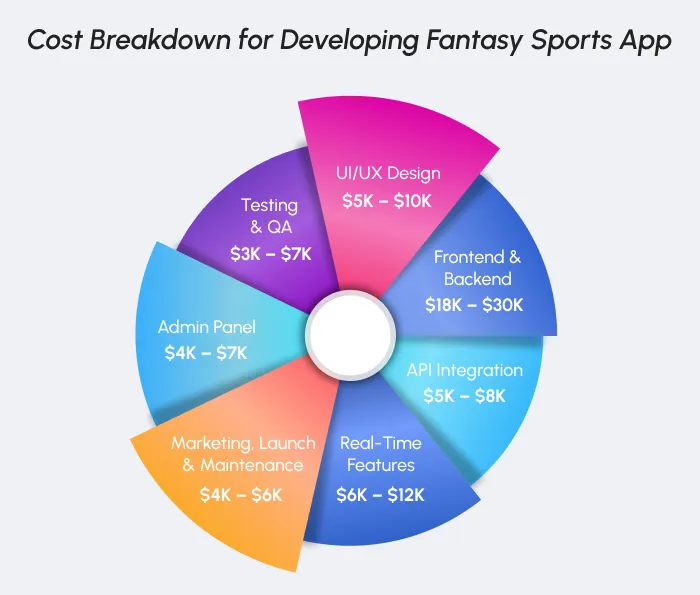
Added together, these components come to $45,000 to $80,000 ($5,000 + $18,000 + $6,000 + $5,000 + $4,000 + $3,000 + $4,000 at the low end, and $10,000 + $30,000 + $12,000 + $8,000 + $7,000 + $7,000 + $6,000 at the high end). That places a typical single-sport build in the mid-range tier. A season-long app similar to ESPN Fantasy, with drafts, trades and commissioner tools, often lands around $100,000 to $120,000 at these rates because of its extra league-management logic. For a precise figure based on your requirements, ask for a scoped quote.
Running Costs to Budget After Launch
The build is only part of the cost. Fantasy apps have usage-driven costs that grow with your audience, so model them before launch.
| Cost item | How it is charged | What to plan for |
|---|---|---|
| Sports data feed | Monthly licence, priced by sport, coverage and latency | Quoted privately by data providers; often the largest monthly line |
| Cloud hosting | Usage-based | Capacity for match-day spikes, when traffic can jump many times above normal |
| App store accounts | Fixed | Apple charges a $99 annual membership; Google Play charges a $25 one-time registration fee |
| Payments and payouts | Per transaction | Card and wallet processing fees on entry fees and withdrawals (paid-contest markets only) |
| KYC and age checks | Per verification | Identity and age checks before deposits or payouts |
| Geolocation checks | Per check or monthly | Required in US states that license paid fantasy contests |
| Maintenance | Annual percentage | 15% to 20% of the build cost each year |
Tip: ask every data provider for a quote at your expected peak traffic, not your average traffic. Scoring delays during live matches are one of the fastest ways to lose paying users.
The Legal Budget: What Regulation Adds to Your Fantasy App Budget
Most cost guides skip this section, yet it can change your budget more than any feature. Use this market-by-market checklist before you sign a development contract.
India: Paid Fantasy Contests Are Banned
India's Promotion and Regulation of Online Gaming Act, 2025 received Presidential assent on 22 August 2025. The government notified the Promotion and Regulation of Online Gaming Rules, 2026 on 22 April 2026, and both the Act and the Rules have applied since 1 May 2026. The key points for app owners are:
- Online money games are prohibited whether they are based on skill, chance or both. Paid fantasy contests fall inside this definition.
- Penalties are severe: offering an online money game can bring up to three years' imprisonment and a fine of up to ₹1 crore, and advertising one can bring up to two years and ₹50 lakh, according to the PRS Legislative Research summary.
- Banks and payment providers are barred from processing transactions for online money games.
- E-sports and online social games can operate, subject to registration with the new Online Gaming Authority of India where required.
The law is still under constitutional challenge. The petitions, led by Head Digital Works v Union of India, were transferred to the Supreme Court in September 2025, and no final judgment had been reported as of early October 2026. Separately, on 27 May 2026 the Supreme Court upheld the Tamil Nadu and Karnataka laws banning online games played for stakes, holding that betting on a game of skill is still gambling once money is staked.
What this means for your budget: build India apps as free-to-play. Remove the wallet, deposit, withdrawal and KYC modules, and spend that budget on ad integration, sponsor-funded prize contests, creator content and retention features. This usually lowers the build cost but makes revenue depend on audience scale.
United States: Licensed State by State
Fantasy contests that meet the conditions in the federal Unlawful Internet Gambling Enforcement Act definitions are excluded from its definition of a bet, but each state sets its own rules.
- Coverage: DraftKings states in its fiscal 2025 results that its daily fantasy sports product is available in 44 states, Washington, D.C. and certain Canadian provinces. Hawaii, Idaho, Montana, Nevada and Washington are commonly listed by state trackers as states where the major DFS apps do not operate.
- Format bans: New York and Michigan have banned "pick'em" contests that mimic player proposition bets, so operators there offer peer-to-peer formats instead.
- California: Attorney General Rob Bonta's opinion No. 23-1001 of 3 July 2025 concluded that daily fantasy contests with players in California are illegal sports wagering. The opinion is not binding law, but it adds legal risk.
- Licence fees: Ohio's fantasy contest operator rule scales the fee with the number of paying Ohio players, reaching $30,000 for the largest operators.
- Taxes: New York charges a 15% tax on gross fantasy revenue plus 0.5% capped at $50,000 a year.
What this means for your budget: add geolocation, age and identity checks, responsible gaming tools (deposit limits, self-exclusion), state-specific contest rules and legal review. These modules typically add several weeks of development plus per-check fees at runtime.
United Kingdom and Other Markets
In the UK, contests where prizes depend on chance or that resemble betting can fall under the Gambling Commission's licensing regime. Elsewhere, rules range from open to prohibited, so get local legal advice before you budget. For a country-by-country overview, read our guide to fantasy sports regulations.
Free-to-Play or Paid Entry: A Quick Cost Scorecard
| Decision point | Free-to-play model | Paid-entry model |
|---|---|---|
| Wallet, deposits and withdrawals | Not needed | Required |
| KYC, age and geolocation checks | Light or none | Required in licensed markets |
| Licence fees and gaming taxes | Usually none | Per state or country |
| Ad and sponsorship stack | Core revenue engine | Optional extra |
| Build cost impact | Lower | Higher, often by weeks of compliance work |
| Revenue risk | Depends on audience scale | Depends on licences staying valid |
Fantasy Sports App Development Timeline by Complexity
The development timeline depends on complexity, features and growth goals. Knowing the likely timeframe helps you plan your launch around a sports season, which matters more for fantasy apps than for almost any other product.
| App level | Development time | Best for | Estimated cost (at about $25/hour) |
|---|---|---|---|
| Basic / MVP version | 3 to 6 months | Startups testing the market | $20,000 to $40,000 |
| Mid-range app | 6 to 9 months | Businesses seeking functionality and scalability | $40,000 to $80,000 |
| Advanced / feature-rich app | 9 to 12 months or more | Enterprises competing with established players | $80,000 to $200,000+ |
A white-label product shortens these timelines considerably because the core contest engine already exists. Startups often choose a simple MVP to test the market before a major tournament, while larger companies build a more advanced app to offer a premium experience.
Options for Building a Fantasy Sports App
Choosing the right way to develop a fantasy sports app affects cost, speed and long-term flexibility. Here are three options.
1. Custom Fantasy Sports App Development
Custom development gives you the most flexibility. Your app is built from the ground up to meet your needs, includes personalized features and can adapt to new technologies like AI or blockchain.
| Pros | Cons |
|---|---|
| Fully tailored to your business needs | Requires the highest initial investment |
| Scalable and flexible as trends change | Longest time to market |
| Long-term control and clear differentiation | Needs strong product ownership on your side |
2. White-Label Fantasy Sports App Solutions
White-label fantasy sports software is pre-built and can be rebranded quickly. It suits companies that want a fast entry into the market or need to test an idea without a large upfront investment.
| Pros | Cons |
|---|---|
| Quick to market | Limited customization |
| Cost-effective | Less scalable for long-term growth |
| Requires less technical skill | Harder to differentiate from competitors |
3. Fantasy Sports Clone App Software
Clone apps replicate the model of popular platforms such as Dream11 or DraftKings. For example, a Dream11 clone script gives you a proven contest flow that users already understand. Note that a Dream11-style paid model can no longer launch in India, so the clone must be adapted to free-to-play there.
| Pros | Cons |
|---|---|
| Quick development | Lack of uniqueness |
| Uses a tested business model | Limited room for innovation |
| Familiar user experience | Needs customization and legal adaptation per market |
To compare the first two options in depth, see our white label vs custom fantasy sports app comparison. Whichever method you choose, partner with a team that can deliver a scalable, compliant product. Hiring a freelancer may look cheaper, but it often brings inconsistent quality, limited support and weak scalability during match-day traffic.
How Do Fantasy Sports Apps Make Money?
Monetization is the backbone of any fantasy sports app, and in 2026 the legal model decides which streams you can use. Here are the most common options; for a deeper look, read our guide on how fantasy sports apps make money.
Entry Fees and Contests
In markets where paid contests are legal, users pay to enter, and the platform keeps a fee (the "rake") from the prize pool. Worked example: 10,000 paid entries a week at $5 each is $50,000 in entry fees. If the platform keeps 12% as its fee, weekly gross revenue is $6,000 (10,000 × $5 × 0.12), or about $312,000 over a 52-week year before taxes, payment fees and marketing. The 12% is an illustrative assumption; set your own after legal and market review.
Advertisements and Sponsorships
Brand partners pay for ads, sponsored contests and prize pools. This is the main revenue engine for free-to-play apps, including in India.
In-App Purchases and Subscriptions
Users buy premium features like advanced stats, lineup tools or an ad-free experience. Subscriptions provide steady income across a season.
Data and Insight Products
With clear user consent and in line with privacy laws, aggregated and anonymized gameplay insights can support sponsor reporting and content partnerships. Never sell personal data without explicit permission.
Why Choose Pixel Web Solutions for Fantasy Sports App Development?
Pixel Web Solutions is an experienced fantasy sports app development company delivering high-quality, scalable and cost-effective solutions tailored to your business model. The team specializes in multi-platform development for iOS, Android and web, so your app performs well on every device.
Pixel integrates secure payment gateways, sports data APIs and compliance modules such as geolocation and KYC where your market requires them. For free-to-play markets, the team builds ad, sponsorship and retention features instead. Beyond development, Pixel provides post-launch support and scaling, including match-day load planning. Pixel operates from Ras Al Khaimah, UAE and Madurai, India, and you can talk to the fantasy sports team for a scoped estimate.
Frequently Asked Questions
How much does it cost to build a fantasy sports app in 2026?
Most fantasy sports apps cost between $20,000 and $200,000+. An MVP of 800 to 1,600 hours costs $20,000 to $40,000 at $25 per hour, or $80,000 to $160,000 at $100 per hour. Compliance work for paid-contest markets adds to this.
How long does it take to develop a fantasy sports app?
A basic MVP takes 3 to 6 months, a mid-range app 6 to 9 months, and an advanced platform 9 to 12 months or more. A white-label solution can launch in weeks.
Is it legal to launch a paid fantasy sports app in India in 2026?
No. Since 1 May 2026, India's Online Gaming Act prohibits online money games, including paid fantasy contests, and bars payment processing for them. Free-to-play fantasy apps can still operate, and the Act's constitutional challenge is pending before the Supreme Court.
In which US states can a daily fantasy sports app operate?
DraftKings reports that its daily fantasy product is available in 44 states and Washington, D.C. Several states require licences and fees, New York and Michigan ban pick'em formats, and California's Attorney General has called daily fantasy contests illegal.
What are the monthly running costs of a fantasy sports app?
Plan for sports data feed licences, cloud hosting sized for match-day spikes, payment and KYC fees in paid markets, and maintenance of 15% to 20% of the build cost per year. Data feeds are often the largest monthly line.
How can I reduce the cost of a fantasy sports app?
Start with one sport and one contest format, use a cross-platform framework, consider a white-label core, and launch before a major tournament to test demand. Then add features based on real user data.
Disclaimer: The costs in this guide are industry estimates to help you plan your financial outlay. For an exact fantasy sports app development cost based on your requirements and target markets, contact Pixel Web Solutions for a detailed consultation and a personalized quote.