Table of Contents
Many prediction market platforms launch with innovative ideas but struggle to scale as user activity grows. Slow trade execution, inaccurate event settlements, security vulnerabilities, and poor system performance often stem from one overlooked factor: a weak platform architecture.
A well-designed prediction market platform architecture is the foundation that keeps every component running seamlessly. From processing prediction trades and managing liquidity to integrating oracle networks and automating smart contract settlements, the right architecture ensures your platform remains secure, scalable, and ready for growth.
In this guide, we’ll break down the essential components of a prediction market platform architecture, explore the different architectural models, and share best practices for building a high-performance platform that delivers long-term business value.
What Is Prediction Market Platform Architecture?
The prediction market platform architecture is the fundamental framework that defines how a prediction marketplace is designed, developed, and operated. It acts as the blueprint that connects core components like the trading engine, smart contracts, oracle networks, liquidity mechanisms, wallets, and security systems. An efficient architecture allows quick trading, automatic settlement of events, security of user funds, and adaptability of the platform for future upgrades.
Why Is Architecture Important for Launching a Prediction Market Platform?
Architecture is what makes the prediction market platform robust, secure, and scalable. It reduces operational risks, helping businesses grow.
- High Performance: Processes transactions and market updates in real time for a smooth user experience.
- Scalability: Supports growing users, markets, and trading volume while maintaining solid performance.
- Enhanced Security: Safeguards users’ funds and platform data through smart contracts, encryption, and access management.
- Transparent Settlement: Automates the process of verifying events and providing rewards with the help of smart contracts and oracle networks.
- Future-Ready Platform: Allows for implementing innovations and improvements in the platform.
Ready to Build Your Prediction Market Platform?
Our experts can help you design the right architecture and build a prediction market platform aligned with your business requirements.
Prediction Market Platform Architecture – A Deep Dive
A prediction market platform consists of multiple interconnected architectural layers that work together to manage users, markets, trading, liquidity, blockchain transactions, event verification, and settlement. The following architecture components form the foundation of a reliable prediction market platform.
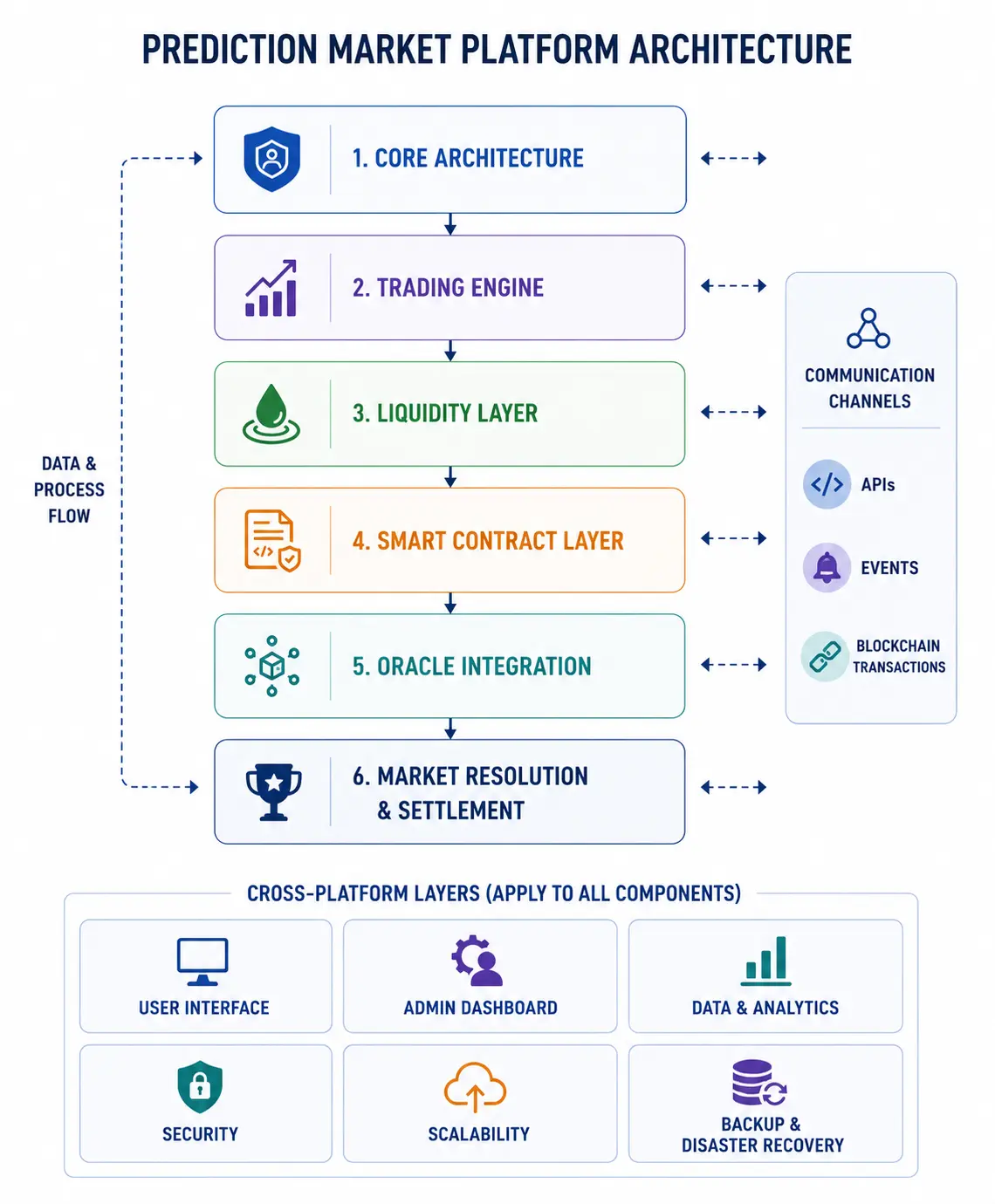 Core Architecture
The core architecture is the foundation layer that ties every module together.
- User management — handles registration, authentication, role-based access, and profile management to keep platform access secure.
- Market management — governs a market’s full lifecycle, from creation and parameter definition through to settlement.
- Business logic layer — enforces platform rules, validates transactions, and coordinates data exchange between the trading engine, smart contracts, and oracle services.
- API gateway — routes requests between client applications and backend services, and handles authentication, rate limiting, and third-party integrations.
- Service communication — moves data between modules using a mix of synchronous APIs (for request/response calls like placing an order) and event-driven messaging (for asynchronous updates like a market settling), which is what lets the trading engine react to an oracle result without polling for it.
Trading Engine Architecture
The trading engine is the heart of the trading process.
- Market creation — defines event details, possible outcomes, trading duration, and settlement rules.
- Order execution — processes buy and sell orders with minimal latency, typically via an in-memory matching engine so order matching doesn’t wait on database writes.
- Dynamic price discovery — updates trading probabilities and prices in real time. Most prediction markets use either an order book model (price set by matched bids/asks) or an automated market maker using a scoring rule like LMSR (logarithmic market scoring rule), which is specifically suited to binary and categorical outcomes because it bounds the market maker’s maximum loss regardless of how lopsided betting gets — unlike a constant-product AMM designed for continuous asset pairs.
- Transaction processing — validates and records trades executed through wallets or smart contracts.
- Risk management — monitors trading activity for wash trading, spoofing, and other manipulation patterns, and can apply position limits on thinly traded markets to reduce single-user price impact.
Liquidity Architecture
This layer guarantees uninterrupted trading across markets.
- Liquidity pools — supply the funds needed for continuous trading and market activity.
- Automated market makers — set prices algorithmically instead of requiring a direct buyer-seller match. LMSR (logarithmic market scoring rule) and similar scoring-rule-based market makers are particularly well suited to binary and categorical markets because they can continue quoting prices in thin markets while providing a defined risk profile for the market maker.
- Order book mechanism — matches buy and sell orders directly, offering tighter spreads in high-volume markets where enough counterparties exist.
- Liquidity incentives — reward liquidity providers, often through a share of trading fees or platform tokens, to keep markets tradeable even on low-interest events.
Smart Contract Architecture
Smart contracts execute key platform functions in an accountable, tamper-resistant way, without manual intervention.
- Market deployment — deploys prediction markets on-chain with defined parameters, outcomes, and settlement logic.
- Escrow management — holds user funds or collateral according to the platform’s settlement model until the market resolves, preventing unauthorized release before settlement.
- Automated market settlement — triggers settlement once a verified outcome is received from the oracle layer.
- Reward distribution — pays out winning positions according to rules encoded in the contract.
- Contract security and upgradability — uses regular third-party audits, formal verification where feasible, and upgrade patterns (such as a proxy pattern) that allow bug fixes without redeploying a new contract address and losing existing market state. Upgradability is a trade-off: it reduces the risk of a permanently broken contract, but it also introduces an admin key that becomes a security target in its own right, so it needs its own access controls (e.g., a timelock or multisig) rather than a single owner address.
Oracle Integration Architecture
This layer ensures smart contracts settle markets accurately, transparently, and without manual involvement — and it’s the layer where prediction markets face their most distinctive risk.
- Data source integration — connects the platform to reliable data providers to obtain event outcomes.
- Event validation — cross-checks event data from multiple sources before accepting it as final, reducing the chance a single bad feed corrupts a settlement.
- Smart contract communication — pushes validated results to smart contracts to trigger settlement.
- Decentralized oracle networks — Admin Dashboard spreads outcome reporting across multiple independent nodes to remove single points of failure.
- Dispute resolution — the practical safeguard most generic architecture write-ups skip. Platforms like UMA use an “optimistic oracle” model: a proposed outcome is accepted unless someone disputes it within a challenge window, at which point token-holder voting or an escalation process resolves the disagreement. This matters because oracle manipulation reporting a false outcome to trigger an incorrect payout is one of the most common real-world attack vectors against prediction markets, and a dispute window is what limits the financial damage of a bad report.
User Interface Architecture
The UI layer is how users actually engage with prediction markets.
- Market discovery — categories, search, filters, and trending events to help users find relevant markets.
- Trading dashboard — a single view of current prices, implied probabilities, open positions, and trade history.
- Wallet and portfolio management — balance checks, transaction history, and position tracking.
- Notifications and alerts — updates on completed trades, market resolution, and time-sensitive events (e.g., a market closing soon).
Admin Dashboard Architecture
The admin layer is where the same core functions from earlier get a management and oversight interface built on top of them — it doesn’t duplicate the underlying logic, it exposes controls for it.
- Operational controls — an interface for the market lifecycle actions (creation, parameter edits, early closure) that Core Architecture executes, plus user-account actions like suspensions and permission changes.
- Transaction monitoring — real-time visibility into trades, deposits, withdrawals, and settlements, typically with alerting thresholds for unusual volume or failed transactions.
- Analytics and reporting — surfaces the metrics produced by the Data & Analytics layer (below) in an operator-facing view: trade volume, liquidity depth, user growth.
- Platform configuration — fee schedules, integration settings, and feature toggles, usually gated behind role-based access so configuration changes are auditable.
Data & Analytics Architecture
This layer turns platform activity into usable insight.
- User analytics — tracks engagement and trading behavior to inform product decisions.
- Market analytics — tracks trading volume, liquidity depth, and market performance.
- Business intelligence — revenue, growth, and operational reporting for strategic planning.
- Real-time reporting — live visibility into transactions, market events, and system health, which is also what feeds the alerting thresholds used in Transaction Monitoring above.
Security Architecture
Security spans every layer above, but a few concerns are distinct enough to call out on their own separate from contract-level audits, which are covered under Smart Contract Architecture.
- Wallet security — secure key management, with multi-signature or MPC (multi-party computation) wallets for custodial platform funds so no single compromised key can drain escrow or treasury balances.
- Data encryption and access control — encrypts sensitive data at rest and in transit, and enforces role-based access control at the infrastructure level (databases, admin tooling, internal services) so a compromised employee account or leaked credential doesn’t expose the whole system.
- API and infrastructure security — firewalls, rate limiting, and DDoS mitigation to protect the API gateway and cloud infrastructure from abuse and denial-of-service attacks, particularly important during high-traffic events when a platform is most attractive to attack.
- Continuous monitoring — real-time threat detection and anomaly monitoring across the platform, feeding the same alerting infrastructure used for transaction monitoring, so unusual login patterns or API abuse get flagged as fast as unusual trading activity.
Beyond these technical measures, platforms should also stay aligned with evolving prediction market regulations and compliance standards, since security and regulatory posture increasingly move together.
Scalability Architecture
Scalability architecture lets a platform serve more users and more transactions without sacrificing performance or uptime.
- Microservices architecture — splits platform functions into independently deployable services so a spike in, say, order matching load doesn’t require scaling the entire application.
- Cloud infrastructure — dynamically adjusts compute capacity to match demand.
- Load balancing — distributes incoming traffic across servers to reduce latency and avoid single-node bottlenecks.
- Database optimization — indexing, caching (e.g., an in-memory cache for live order book state), and read replicas to handle higher transaction volume without slowing writes.
- Auto-scaling and high availability — automatic resource allocation and failover so a traffic surge (a high-profile market going viral, for instance) doesn’t degrade execution speed platform-wide.
Backup & Disaster Recovery Architecture
This layer protects platform data and enables fast recovery from failures, cyberattacks, or infrastructure outages.
- Automated backups — regular backups of user data, transaction history, and platform databases.
- Disaster recovery — documented, tested recovery procedures so operations can resume quickly after a failure.
- High availability — redundant infrastructure and failover mechanisms to minimize downtime.
- Continuous monitoring — real-time tracking of system health and backup integrity to catch failures before they become outages.
Prediction Market Platform Architecture Models
Choosing the architecture is crucial for building a prediction marketplace that aligns with your business objectives, targeted users, and scalability goals. Depending on the operational model and regulation requirements, you can choose between centralized, decentralized, or hybrid architecture.
Centralized Architecture
The centralized architecture is where one business is in charge of running the platform, including the management of the user accounts, markets, liquidity, and settlements. This approach allows for greater control, quicker transaction processing, and easier KYC/AML compliance.
Key Characteristics
- Centralized user and market management
- Quick transaction processing
- Simple governance of the platform
- Easy compliance with KYC/AML regulations
- Higher complexity of the infrastructure
Decentralized Architecture
The decentralized architecture leverages blockchain networks and smart contracts to process transactions without any central authority. The market, trading, and settlements are performed on the blockchain, allowing users to manage their assets with greater security and trust.
Key Characteristics
- Smart contract-driven operations
- Non-custodial wallet integration
- Transparent and immutable Transactions.
- Community-backed governance.
- Enhanced security
Hybrid Architecture
A mixed structure is a combination of both centralized structure and decentralized structure. The main operational tasks of the business are executed in an off-chain manner, while blockchain technology is implemented in the processes of trading and smart contracts. Thus, high levels of scalability and effectiveness are reached.
Key Characteristics
- Centralized business administration
- Decentralized trading and settlement
- Improved scalability and performance
- Flexible blockchain integration
- Better user experience with enhanced security
|
Architecture |
What it Offers |
| Centralized |
Operational Control & Regulatory Flexibility |
|
Decentralized |
Transparency & Trust |
| Hybrid |
High performance, scalability, security, and user experience |
The ideal Prediction market platform architecture depends on your business goals, compliance requirements, and target market.
Best Practices for Building a Scalable Prediction Market Platform Architecture
By following the below-listed proven architectural practices help businesses can create reliable prediction market platforms.
- Build a Modular Architecture: Build independent modules for trading, smart contracts, wallets, and user management to simplify maintenance and enhancements.
- Integrate Reliable Oracle Networks: Choose reliable oracle providers to ensure the trustworthiness of event verification and seamless market regulation.
- Prioritize Smart Contract Security: Conduct regular audits and code investigations to protect users’ funds and reduce security flaws.
- Design for Scalability: Use cloud computing technologies, microservices, and load balancing to handle increasing numbers of users and transactions.
- Optimize Liquidity Management: Utilize liquidity pools or AMM solutions for better price discovery and hassle-free trading.
- Continuously Monitor Performance: Supervise the performance of the platform, the activities on the exchange, and the work of the infrastructure.
Build Your Prediction Market Platform with Pixel Web Solutions
Pixel Web Solutions is a Prediction Market Platform Development Company designing secure and scalable platforms for over a decade. Our team of experts designs and develops custom prediction marketplaces using technologies such as blockchain, smart contracts, oracle integrations, and scalable cloud infrastructure.
We help businesses from planning the architecture of prediction market platforms to launch & ongoing maintenance support. We help you launch a future-ready solution that drives user engagement and business growth. Our Expertise Includes,
- Custom Prediction Market Platform Development
- Smart Contract Development & Audit Services
- On-time Platform Launch
- Ensuring High Security & Scalability
- Post-Launch Maintenance & Support
Have a Prediction Market Idea? Let’s Discuss It.
Get expert guidance on planning your prediction market platform architecture and choosing the right technology approach for your business requirements.
Frequently Asked Questions (FAQs)
1. Why is prediction market platform architecture important?
A robust architecture ensures secure transactions, seamless trading, transparent settlements, high performance, and the scalability required to support long-term business growth.
2. How much does it cost to develop a prediction market platform?
The development cost ranges from $25,000 to $150,000 depending on the platform architecture, blockchain integrations, features, and customization requirements. More complex architectures generally require higher investment.
3. How long does it take to build a prediction market platform?
The timeline depends on the project’s scope and complexity. An MVP typically takes 8–12 weeks, while a fully customized enterprise-grade platform may take 16–24 weeks.
4. What blockchain is best for building a prediction market platform?
It depends on your priorities. Ethereum has the most mature tooling and liquidity but higher gas costs; L2s like Polygon or Arbitrum cut costs while staying compatible. Hybrid architectures can even support multiple chains.
5. Can a prediction market platform be built without blockchain?
Yes. A fully centralized architecture can run entirely off-chain using a traditional database, trading transparency for simpler infrastructure and easier compliance.
6. What’s the difference between a prediction market and a betting platform?
Prediction markets use continuous price discovery; the price reflects real-time crowd probability, and positions can be traded before the event resolves. Betting platforms typically lock in fixed odds with no secondary trading.