








Prediction market regulations depend on how each country classifies an event contract: as a regulated derivative, as gambling, or as a virtual asset activity. In the US, event contracts trade on CFTC-designated contract markets such as Kalshi and Polymarket US, but states are challenging sports contracts in court and the question is now before the Supreme Court; in the UK, the EU and the UAE, operators need a gambling or financial licence, or must block users entirely. Compliance for a prediction market therefore starts with choosing a jurisdiction and licence route, then building KYC, AML, geofencing and market integrity controls into the platform.
Prediction markets have grown into one of the most visible applications of blockchain and financial technology. In August 2026, average monthly trading in event contracts on CFTC-registered exchanges was about $1.5 billion, of which about $1.2 billion was sports, according to the CFTC's October 2026 proposed rule. As volumes rise, regulators are tightening their grip, and courts are deciding who those regulators should be.
For entrepreneurs planning to launch a prediction market platform, understanding the rules is as important as developing the technology. Ignoring them can lead to lawsuits, penalties, forced geoblocking or a shutdown. This guide covers the regulators that matter, the US position as of October 2026, the rules in the EU, UK and UAE, the compliance features every platform needs, and a checklist for launch.
Key Takeaways
- The US is federal and contested: event contracts trade on CFTC-designated contract markets (DCMs). On 9 October 2026 the CFTC proposed writing event contracts on sports, politics, culture and weather into its "swap" definition, while excluding casino-style gambling.
- Courts are split: the Third Circuit sided with Kalshi in April 2026, while the Ninth Circuit (August 2026) and Sixth Circuit (September 2026) held that sports event contracts are not swaps. New Jersey's petition is docketed at the Supreme Court as No. 26-299.
- Polymarket returned to the US through a licensed exchange: after a $1.4 million CFTC penalty in 2022, it operates in the US through QCX LLC, a CFTC-registered DCM, with CFTC staff no-action relief issued in September and December 2025.
- Outside the US, licensing is the gate: the EU has no EU-wide gambling law, the UK splits oversight between the Gambling Commission and the FCA, and the UAE has no dedicated prediction market framework. Polymarket's own geoblock list restricts the US, UK, France, Germany, Italy and dozens of other jurisdictions.
- Compliance is a feature set: KYC, AML, sanctions screening, geofencing, market surveillance, clear resolution rules and responsible gaming controls must be designed in, not added later.
- Budget for build plus legal: Pixel Web Solutions builds prediction market platforms from $7,000; licensing, legal opinions and audits are separate costs.
Why Prediction Market Platforms Prioritize Compliance?
Regulatory compliance is essential for any prediction market platform. It builds a safe, reliable environment for users and investors and supports stable, long-term growth. For many businesses, it decides whether they can operate at all.
Here are the main benefits compliance brings to prediction market platforms.
Build User Trust
A compliant platform earns a good reputation and attracts more users. Verified identities, segregated customer funds and clear market rules show users that the platform is legitimate and transparent.
Reduce Risk of Legal Disputes
A compliant prediction market platform keeps its operations within the law, which reduces exposure to lawsuits, cease-and-desist orders and penalties. In 2026, US state attorneys general have filed civil and even criminal actions against prediction market operators.
Access New Markets and Partners
Compliance opens doors to new markets and to partners such as banks, payment processors, brokerages and sports leagues.
Attract More Investors
Regulatory compliance also helps a prediction market platform gain credibility with investors. A licensed company has a better chance of raising capital and hiring senior talent.
Enhance Platform Security
Compliance usually requires security standards that protect user data and funds, which reduces fraud and breach risk.
Regulatory compliance forms the foundation of a successful prediction market platform, but understanding who writes and enforces the rules matters just as much. Let's look at the major regulators.
Wondering If Your Platform Meets Regulatory Requirements?
Every prediction market platform has unique compliance requirements. Our experts can help you navigate regulatory planning and platform development with ease.
Major Regulatory Compliance Governing Prediction Markets
Prediction market platforms are regulated in many jurisdictions, and the rules change with the type of contract and the platform's reach. Knowing each regulator's role helps you plan a route to market and reduce legal risk.
Commodity Futures Trading Commission (CFTC)
The Commodity Futures Trading Commission (CFTC) regulates futures, options and swaps in the United States, including event contracts listed on designated contract markets. It treats event contracts as derivatives within its jurisdiction: its 2022 order against Polymarket found that event market contracts are swaps that can only be offered on a registered exchange, and fined the operator $1.4 million.
The CFTC aims to keep the markets it oversees fair and transparent and to protect traders from fraud and manipulation. Any company planning a prediction market for US users must either become a DCM, partner with one, or keep US users out.
The CFTC primarily focuses on:
-
Preventing market manipulation and insider trading
-
Protecting market participants and their funds
-
Reviewing and regulating event contracts listed by DCMs
-
Promoting transparent trading and data reporting
As of 1 September 2026, at least seven CFTC-registered DCMs offered event contracts, according to the CFTC's proposal.
Financial Action Task Force (FATF)
The Financial Action Task Force (FATF) sets global standards for fighting money laundering and terrorist financing. FATF does not regulate businesses directly, but most countries build their laws on its recommendations, including its standards for virtual assets and service providers. Platforms handling digital assets and real-money transactions should apply these standards to stay compliant and bankable worldwide.
-
Customer identity verification
-
Risk-based AML programs
-
Transaction monitoring
-
Suspicious activity reporting
-
Sanctions screening and the travel rule for crypto transfers
FATF recommendations shape AML laws across its global network of member and associate jurisdictions.
European Securities and Markets Authority (ESMA)
The European Securities and Markets Authority (ESMA) promotes investor protection, transparency and integrity in EU financial markets. A prediction market contract that pays a fixed amount depending on an outcome can be a binary option, and derivatives are financial instruments under MiFID II, as ESMA's guidelines on crypto-assets and financial instruments confirm for crypto-referenced derivatives. Crypto-asset services used by the platform fall under the Markets in Crypto-Assets Regulation (MiCA), and GDPR governs user data.
-
Investor protection
-
Financial market transparency
-
Cross-border regulatory consistency
-
Market stability
Prediction market operators serving European users should map each product to MiFID II, MiCA, national gambling law and GDPR.
Financial Conduct Authority (FCA)
The Financial Conduct Authority (FCA) regulates financial services and investment business in the UK. Since 2 April 2019, the FCA has permanently banned the sale, marketing and distribution of binary options to retail consumers by firms acting in or from the UK. That makes a retail financial-product route for UK prediction markets very narrow.
-
Consumer protection
-
Financial crime prevention
-
Market integrity
-
Licensing of regulated businesses
Platforms targeting UK users must decide whether they are offering financial products (FCA) or betting (Gambling Commission).
UK Gambling Commission
The UK Gambling Commission licenses betting operators under the Gambling Act 2005, including betting exchanges where users bet against each other. A prediction market run as peer-to-peer betting for UK residents needs a remote operating licence, with its rules on age verification, safer gambling, AML and fair terms.
Virtual Assets Regulatory Authority (VARA)
The Virtual Assets Regulatory Authority (VARA) regulates virtual asset activities in Dubai, outside the DIFC. A blockchain prediction market that holds customer crypto, issues tokens or runs an exchange-like service in Dubai would need VARA licensing for those virtual asset activities. However, VARA has not published rules specific to prediction markets, so the gambling question still applies.
-
Licensing
-
AML compliance
-
Cybersecurity
-
Consumer protection
-
Risk management
General Commercial Gaming Regulatory Authority (GCGRA)
The UAE's federal GCGRA, formed in September 2023, oversees commercial gaming, including lottery, internet gaming and sports wagering. A Norton Rose Fulbright analysis from April 2026 notes that it is still unclear whether event contracts fall under the GCGRA, a financial regulator, or both, and that the UAE has no framework dedicated to prediction markets.
| Regulatory authority | Region | Purpose | Key focus |
|---|---|---|---|
| CFTC | United States | Regulates DCMs and the event contracts they list | Event contracts, market integrity, fraud prevention |
| FATF | Global | Sets AML and CFT standards | KYC, AML, travel rule, sanctions |
| ESMA | European Union | Oversees securities markets and investor protection | MiFID II, MiCA, transparency |
| FCA | United Kingdom | Regulates financial services | Retail binary options ban, licensing, financial crime |
| UK Gambling Commission | United Kingdom | Licenses betting and betting exchanges | Operating licences, safer gambling, AML |
| VARA | Dubai, UAE | Regulates virtual asset businesses | Licensing, AML, cybersecurity |
| GCGRA | UAE (federal) | Regulates commercial gaming | Lottery, internet gaming, sports wagering |
These regulators set the legal and operational standards prediction market platforms must follow in each region. The next section looks at the fast-moving US picture in detail.
US Prediction Market Regulation as of October 2026
The United States is where most prediction market volume trades, and where the rules changed most in 2026.
The CFTC's October 2026 rulemaking. On 9 October 2026 the CFTC issued an interim final rule excluding casino-style gambling from the definition of "swap", and a companion proposal to add "[e]vent contracts, including those based on sports-, politics-, cultural-, and weather-related events" to that definition. The proposal carries a 30-day comment period after publication in the Federal Register. If adopted, it would strengthen the CFTC's argument that federal law preempts state gambling rules for contracts listed on DCMs.
The court split. Three federal appeals courts have ruled on sports event contracts:
| Court | Date | Holding | Effect |
|---|---|---|---|
| Third Circuit (KalshiEX v. Flaherty, New Jersey) | 6 April 2026 | Sports event contracts on a CFTC-licensed DCM fit the swap definition | Federal law preempts New Jersey's gambling statute |
| Ninth Circuit (KalshiEX v. Assad, Nevada) | 28 August 2026 | Sports event contracts are likely not swaps | Nevada can enforce its gaming laws; rehearing petition filed |
| Sixth Circuit | September 2026 | Sports event contracts are not swaps, on different reasoning | Sides with state regulators |
All three decisions are summarised, with citations, in the CFTC's October 2026 proposal linked above.
The Supreme Court. New Jersey's petition, Flaherty v. KalshiEX, No. 26-299, was docketed on 8 September 2026. Kalshi's response is due 9 November 2026, and amicus briefs have come from gaming regulators, tribes, states and the NFL.
State actions. According to the CFTC, Minnesota enacted a law making it a felony to offer event contracts on athletic events, elections and other events; Arizona filed a twenty-count criminal information against a DCM; New York sought an order that would bar a New York-based DCM from offering sports, culture and election contracts; and state courts ordered geofencing in Michigan, Washington and Nevada.
Polymarket's route back. Polymarket left the US after the 2022 CFTC order. It then acquired QCEX, and its exchange QCX LLC received CFTC staff no-action relief on swap data reporting in Letter 25-28 (2 September 2025), modified for Polymarket's contracts in Letter 25-48 (11 December 2025). QCX LLC, trading as Polymarket US, is a CFTC-registered DCM and runs separately from the offshore Polymarket exchange.
What this means for a new platform: a US launch today means becoming or partnering with a DCM, expecting state-level challenges for sports contracts, and building geofencing that can switch states on or off at short notice.
Common Compliance Features for Prediction Market Platforms
Building a prediction market platform is not only about innovative features and a good user experience. A well-designed prediction market platform architecture is what makes scalability, security and compliance possible. Below are the compliance features a prediction market platform must have before launch, and the rules each one answers.
| Feature | What it does | Rule it answers |
|---|---|---|
| Licensing and registration | Secures the financial, gaming or virtual asset licence the model needs | CFTC DCM designation, UK Gambling Act, VARA, GCGRA |
| KYC compliance | Verifies identity, age and residence before trading | FATF, CFTC customer rules, gambling licence conditions |
| AML and sanctions screening | Monitors transactions, screens wallets and flags suspicious activity | FATF, national AML laws, travel rule |
| Geofencing | Blocks or limits users by country and, in the US, by state | Court orders, state gambling laws, foreign bans |
| Market surveillance | Detects manipulation, wash trading and insider trading | CFTC core principles, market abuse rules |
| Clear contract and resolution rules | Publishes how each market resolves, the data source and dispute process | CFTC contract review, consumer protection |
| Data protection | Applies GDPR, CCPA and similar privacy laws | Data protection laws |
| Consumer protection | Clear terms, risk disclosures, fair treatment | Consumer and gambling law |
| Smart contract audits | Reviews contracts and oracles before launch and after changes | Platform security and custody rules |
| Tax compliance | Keeps transaction records and user tax reports | National tax rules |
| Responsible gaming | Deposit limits, self-exclusion, age checks | Gambling licence conditions |
With these features in place, a prediction market platform can operate in a regulation-friendly way. Requirements still differ by jurisdiction, so the next step is to understand each region.
Prediction Market Regulatory Landscape by Region
Prediction market regulations are far from uniform, because countries treat event contracts as financial products, gambling or both. This should guide which market you launch in first and which licence you apply for.
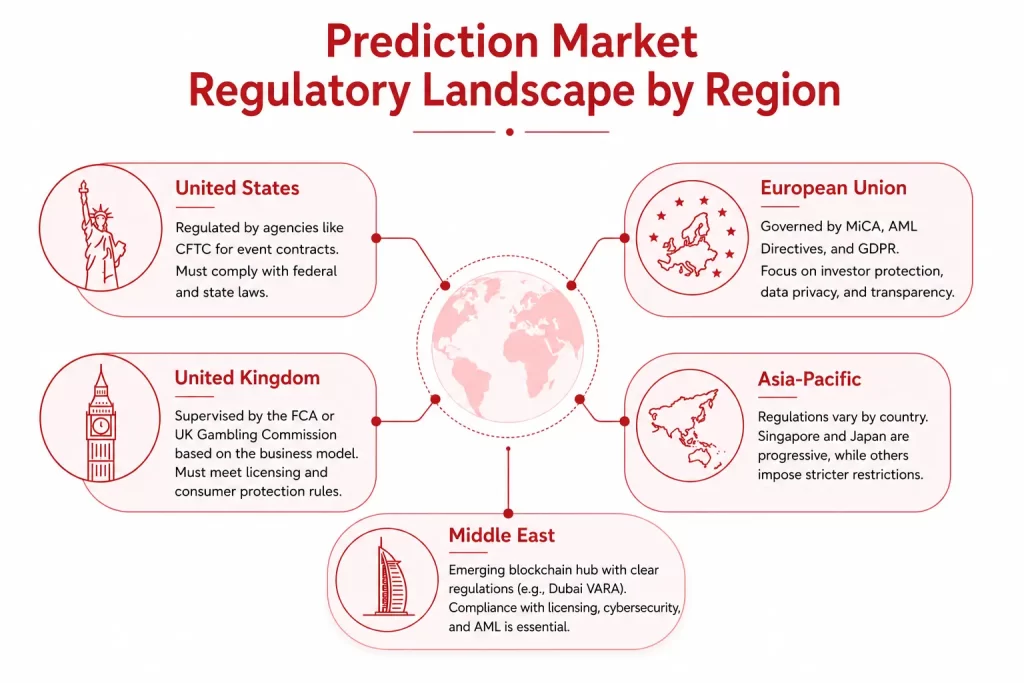
United States
Event contracts are regulated by the CFTC when listed on a DCM, as covered above. Companies must also plan for state gambling laws, which several states are enforcing against sports contracts, and for the Supreme Court's eventual answer on preemption.
European Union
"There is no sector-specific EU legislation in the field of gambling services," according to the European Commission, so each member state licenses or bans betting on its own terms. Event contracts structured as financial products fall under MiFID II, crypto-asset services under MiCA, and all user data under GDPR. In practice, many EU states treat unlicensed prediction markets as illegal gambling.
United Kingdom
The UK has two regulators to consider: the FCA, which bans retail binary options, and the UK Gambling Commission, which licenses betting and betting exchanges. A UK prediction market for retail users is, in practice, a gambling-licensed betting exchange.
Asia-Pacific
Regulation across APAC is diverse, so each jurisdiction needs its own study. Singapore, Taiwan, Thailand and Japan appear on Polymarket's restricted list, and Australia is restricted too.
Middle East
The UAE is adopting blockchain and virtual assets quickly, with VARA in Dubai, ADGM's FSRA in Abu Dhabi and the federal GCGRA for commercial gaming. Gambling remains a criminal offence under the UAE Penal Code outside GCGRA-licensed activity, and there is no dedicated prediction market framework yet. Companies should obtain a formal legal opinion on classification before offering event contracts to UAE residents.
Since requirements differ across regions, businesses should run a legal assessment before launching internationally, especially when modelling a platform on Kalshi or Polymarket, which operate under very different regulatory frameworks.
Where the Market Leaders Block Users: A Real-World Compliance Map
One of the clearest signals of how regulators view prediction markets is where the largest operator chooses not to serve. Polymarket's developer documentation publishes its restricted jurisdictions, as read on 16 October 2026:
| Restriction level | Jurisdictions (examples from Polymarket's list) |
|---|---|
| Blocked completely (sanctions) | Iran, Syria, Cuba, North Korea, Crimea, Donetsk and Luhansk regions |
| Close-only on frontend and API (regulatory) | United States, United Kingdom, France, Germany, Italy, Belgium, Poland, Slovakia, Australia, New Zealand, Singapore, Taiwan, Thailand, Brazil, Russia, Ontario, British Columbia, Alberta and Quebec, among others |
| Close-only on frontend (regulatory) | Ireland, Japan, Netherlands, Malta (sports only) |
"Close-only" means users can exit positions but cannot open new ones. Three lessons follow for a new operator:
- Your geofencing must handle sub-national regions, such as Canadian provinces and US states, not just countries.
- Partial restrictions are real: Malta is restricted for sports markets only, so market-level geofencing (by category) is needed, not just account-level blocks.
- The UAE is not on the list, but that reflects a legal grey area rather than a green light; a UAE launch still needs a classification opinion.
Compliance Checklist for Building a Prediction Market Platform
Launching a prediction market platform takes more than advanced features; it needs a strong compliance framework for legal operation and user trust. Before going live, confirm that every regulatory, security and operational requirement is in place.
Here's a compliance checklist for building a prediction market platform:
-
Determine your platform's regulatory classification (derivative, gambling or virtual asset service) in each target market, with a written legal opinion.
-
Choose a route: become a DCM, partner with one, obtain a gambling licence, or launch offshore with strict geoblocking.
-
Obtain all required licences and registrations before onboarding users.
-
Implement KYC and AML procedures, including sanctions and wallet screening.
-
Build geofencing at country, state or province, and market-category level.
-
Write clear contract specifications and resolution rules for every market, including the data source and dispute process.
-
Ensure compliance with data privacy laws (GDPR, CCPA and others).
-
Prepare legal documents, including terms and conditions, risk disclosures and a privacy policy.
-
Strengthen security with encryption, MFA, segregated funds and smart contract audits.
-
Set up market surveillance for manipulation, wash trading and insider trading.
-
Keep accurate financial records and meet tax reporting rules.
-
Add responsible gaming features where required, then run regular compliance and security audits and track regulatory changes.
Following this checklist helps businesses establish a secure, transparent and regulation-ready prediction market platform. Putting each point into practice is demanding, so it helps to work with a technology partner experienced in these platforms. Pixel Web Solutions offers end-to-end prediction market platform development built to meet changing compliance standards while keeping performance and scale.
Ready to Build a Regulation-Ready Prediction Market Platform?
Meeting compliance requirements is only the beginning. Build a prediction market platform with the right technology, security, and compliance framework to support a successful launch.
How Much Does a Compliant Prediction Market Platform Cost?
Compliance adds work in three places: the build (KYC, geofencing, surveillance, audit logs), the licence and legal opinions, and ongoing operations (monitoring, reporting, audits).
On the build side, Pixel Web Solutions develops prediction market platforms from $7,000 for a focused launch. Compliance-heavy features such as multi-level geofencing, surveillance dashboards and integrations with DCMs or brokers add to that base. Licensing, legal and audit fees depend on the jurisdiction and are paid to third parties. For a full breakdown by feature and model, see the guide to the cost to build a prediction market platform.
If you are modelling your product on a specific market leader, the step-by-step guides on how to build a prediction market platform like Polymarket and how to create a prediction market platform like Kalshi show how each one's architecture follows from its regulatory route. For a view of how today's leading operators compare on volume and markets, see the ranking of top prediction market platforms.
Build a Regulation-Ready Prediction Market Platform with Pixel Web Solutions
Pixel Web Solutions helps startups and enterprises bring secure, scalable and regulation-ready prediction markets to market. Its team develops and integrates KYC and AML tools, geofencing, market surveillance and other security measures, and builds the smart contracts and custom platforms behind centralized or decentralized prediction markets. To plan your launch route and platform, contact Pixel Web Solutions.
Frequently Asked Questions
Are prediction markets legal?
Prediction markets are legal in some jurisdictions, depending on the country's rules and the platform's model. In the US, event contracts are legal on CFTC-designated contract markets, although several states are challenging sports contracts in court. In many other countries they are treated as gambling and need a betting licence, or are not allowed.
Do prediction markets need a license?
Yes, in almost every market. A US platform needs CFTC designation as a DCM or must partner with one; a UK platform for retail users needs a Gambling Commission licence; a crypto-based platform in Dubai needs VARA licensing for its virtual asset activities, plus clarity on gambling rules.
Is Polymarket legal in the US?
Polymarket serves US users through its CFTC-registered exchange, QCX LLC (Polymarket US). Its offshore international platform still restricts US users, according to Polymarket's published geoblock list.
Is Kalshi regulated by the CFTC?
Yes. Kalshi operates as a CFTC-designated contract market. Several states dispute its sports contracts, and the Supreme Court is considering New Jersey's petition in Flaherty v. KalshiEX (No. 26-299).
Is KYC mandatory for prediction market platforms?
Yes, KYC is mandatory for regulated platforms that handle real money or digital assets. KYC and AML procedures prevent fraud, money laundering and underage or out-of-area users, and they are a condition of every major licence.
What regulations apply to decentralized prediction markets?
Decentralized prediction markets can still be subject to derivatives, gambling, AML, consumer protection, tax and virtual asset rules. Running on smart contracts does not exempt the operator: the CFTC's 2022 order against Polymarket covered a blockchain-based platform whose operator created and resolved the markets.
Are prediction markets legal in the UAE?
The UAE has no dedicated framework for prediction markets. Gambling is restricted outside GCGRA-licensed activity, and it is unclear whether event contracts fall under gaming or financial regulation. Get a UAE legal opinion before serving UAE residents.
How can I build a compliant prediction market platform?
Start by choosing your jurisdiction and licence route, then build KYC, AML, geofencing, market surveillance and clear resolution rules into the platform. Partnering with an experienced prediction market development company helps you build with compliance, scale and long-term success in mind.
Conclusion
Prediction market regulations in 2026 are being written in real time: by the CFTC's October rulemaking, by a split among federal appeals courts, by state lawmakers and by licensing regimes in London, Brussels and Abu Dhabi. The platforms that last are the ones that pick a clear licence route, geofence precisely and treat compliance as a core product feature. Plan your regulatory route first, then build the technology around it, and your prediction market will be ready for whatever the Supreme Court and regulators decide next.