









Table of Contents
Last updated: 4 October 2026 | Reviewed by Mathibharathi Mariselvan, Co-founder, Pixel Web Solutions | 15 min read
The cost to build a prediction market platform in 2026 starts at $7,000 for a focused platform with binary markets and core trading, and runs from $25,000 to $150,000+ for white-label, MVP and fully custom builds. A basic white-label or MVP platform costs $25,000 to $50,000, an advanced MVP $50,000 to $100,000, and a platform built from scratch $100,000 to $150,000 or more. Budget separately for liquidity, oracles, legal work and marketing, which can add $30,000 or more.
Prediction markets have grown from a niche concept into a fast-growing business, expanding beyond sports into politics, finance, and real-world events. Platforms traded $77.7 billion of contracts in September 2026 alone, so many businesses are exploring prediction market platform development to capitalize on the demand. But one of the biggest questions remains:
How much does it cost to build a prediction market platform?
In this guide, we break down the prediction market platform development cost, covering development approaches, key cost factors, hidden expenses, and budgeting insights. Drawing on over a decade of blockchain expertise, Pixel Web Solutions provides practical guidance to help you plan your investment effectively.
Key Takeaways
- Costs start at $7,000: Pixel Web Solutions builds a focused prediction market with binary markets and core trading from $7,000.
- Most full builds cost $25,000 to $150,000+: basic white-label or MVP $25,000 to $50,000, advanced MVP $50,000 to $100,000, and from scratch $100,000 to $150,000 or more.
- Plan beyond development: oracles, liquidity, upgrades and integrations can add $30,000 or more, plus legal and marketing budgets.
- Smart contracts, the trading engine, liquidity and security drive most of the build effort and decide how well the platform scales.
- Revenue comes from trading fees, market creation fees, premium features and ads, and demand is real: Kalshi alone handled about 78% of the $77.7 billion traded in September 2026.
How much does it cost to build a Prediction Market Platform?
The cost to build a prediction market platform ranges from $7,000 for a focused platform to $25,000 to $150,000+ for white-label, MVP, and custom builds. The exact investment depends on the development approach, platform architecture, blockchain integration, smart contract functionality, UI/UX design, security requirements, and ongoing maintenance. The table below compares estimated costs and timelines for each approach.
| Development Approach | Estimated Timeline | Estimated Cost |
|---|---|---|
| Focused platform: binary markets and core trading | Scoped per project | From $7,000 |
| MVP Approach with Basic Features | 8 to 12 Weeks | $25,000 to $50,000 |
| MVP Approach with Advanced Features | 12 to 16 Weeks | $50,000 to $100,000 |
| Prediction Market Platform Development From Scratch | 16 to 24 Weeks | $100,000 to $150,000+ |
Focused Prediction Market Platform
A focused prediction market platform with binary markets and core trading functionality starts at $7,000.
This is the leanest way to launch. It covers yes or no markets, a single resolution model, and the core trading flow. Costs rise with mechanism complexity, on-chain settlement, dispute handling, compliance scope, and the number of jurisdictions you serve.
MVP/White Label Prediction Market Platform with Basic Features
A white label or an MVP of a prediction market platform with basic features might cost between $25,000 to $50,000.
This approach suits businesses that want to launch quickly, with about 8 to 12 weeks of development. A basic MVP focuses on essential functions such as simple trading mechanisms, limited market creation, and a straightforward user interface. A ready-made Polymarket clone script is a common starting point at this level.
Customization is limited, as the platform comes with a basic set of features. This is the best option for startups that want to test the waters with minimal investment.
MVP/White Label Prediction Market Platform with Advanced Features
A white label or an MVP of a prediction market platform with advanced features might cost between $50,000 to $100,000.
This model is more advanced and might take 12 to 16 weeks to launch. The software includes an enhanced UI/UX, advanced trading functions, and analytical tools.
This approach is best for businesses that want to launch cost-effectively, yet with advanced features and functionality.
Prediction Market Platform Development from Scratch
Building a prediction market platform from scratch might cost around $100,000 to $150,000 or more.
Custom development can take 16 to 24 weeks. This approach suits businesses with a long-term vision and unique requirements. Every component, from the base architecture to the trading engine, is built from the ground up. Our guide to prediction market platform architecture shows what those components are.
This method offers complete control over features and integrations, so the platform can stand out in a competitive market.
Find the Right Development Approach for Your Platform
Discover the exact development approach your platform requires based on your goals, budget, and scalability plans.
Key Factors That Affect the Prediction Market Platform Development Cost
Several key factors influence the overall cost to build a prediction market platform. As a leading Prediction Market Platform Development Company, Pixel Web Solutions has spent over a decade building secure blockchain and fintech applications for businesses worldwide. Based on our hands-on work in prediction market platform development, we have identified the major factors that determine the cost. The table below gives an estimated cost range for each factor, so you can see how technical and business requirements shape the total investment.
| Influencing Factor | Estimated Cost Range |
|---|---|
| Type of Prediction Market Platform | $2,000 to $12,000 |
| Blockchain Selection | $2,000 to $8,000 |
| Smart Contract Development | $3,000 to $20,000 |
| UI/UX Development | $2,000 to $15,000 |
| Features Integrated | $3,000 to $25,000 |
| Project Complexity | $3,000 to $20,000 |
| Tech Stack | $4,000 to $18,000 |
| Security & Audits | $3,000 to $12,000 |
Type of Prediction Market Platform
The type of prediction market has a big impact on the overall development cost. Platforms built for sports, politics, finance, cryptocurrency, entertainment, or other real-world events need different functions, third-party integrations, and business logic, which changes the development scope.
- Centralized Prediction Platforms
Centralized platforms are managed by a single authority that controls user accounts, transactions, and market settlements. They are easier to manage, quicker to launch, and suit businesses that want a simple operating model.
- Decentralized Prediction Platforms
Decentralized prediction platforms run on blockchain technology and use smart contracts to automate market creation and settlement. They offer greater transparency, security, and trust but need more advanced blockchain development.
- Hybrid Prediction Platforms
Hybrid platforms combine the efficiency of centralized systems with the transparency of decentralized infrastructure. This gives businesses more flexibility, better scalability, and a balanced user experience.
Blockchain Selection
The blockchain network you choose shapes platform performance and long-term operating efficiency. Evaluate transaction speed, scalability, network fees, ecosystem maturity, and integration requirements before development begins.
Smart Contract Development
Smart contracts automate essential functions such as market creation, prediction execution, fund management, and reward distribution. Because these contracts handle money directly, they must be securely developed, thoroughly tested, and professionally audited.
UI/UX Development
A well-designed interface increases engagement and makes it easy to join markets. Intuitive navigation, responsive layouts, interactive dashboards, and real-time market updates all shape the user experience.
Features Integrated
The number and complexity of features directly affect development effort. Advanced functions such as trading engines, liquidity mechanisms, oracle integration, analytics dashboards, admin panels, and wallet connectivity need extra planning, development, and testing.
Project Complexity
Overall complexity depends on functionality, business logic, and third-party integrations. Platforms with multiple market types, advanced trading mechanisms, AI-powered analytics, or real-time data processing need more sophisticated development.
Tech Stack
The technology stack determines the platform's performance, scalability, and future maintenance. The right frontend frameworks, backend technologies, blockchain tools, databases, and cloud infrastructure keep a prediction market platform reliable and fast.
Security & Audits
Security is one of the most critical parts of prediction market platform development. Secure authentication, data encryption, vulnerability assessments, penetration testing, and smart contract audits protect user assets and support regulatory compliance and platform integrity.
Did You Know?
Prediction markets traded $77.7 billion of contracts in September 2026, up 53% from August, according to DeFi Rate's volume tracker. Sports made up 67% of the dollars paid on single markets.
Cost to Develop a Prediction Market Platform: Phase-by-Phase Breakdown
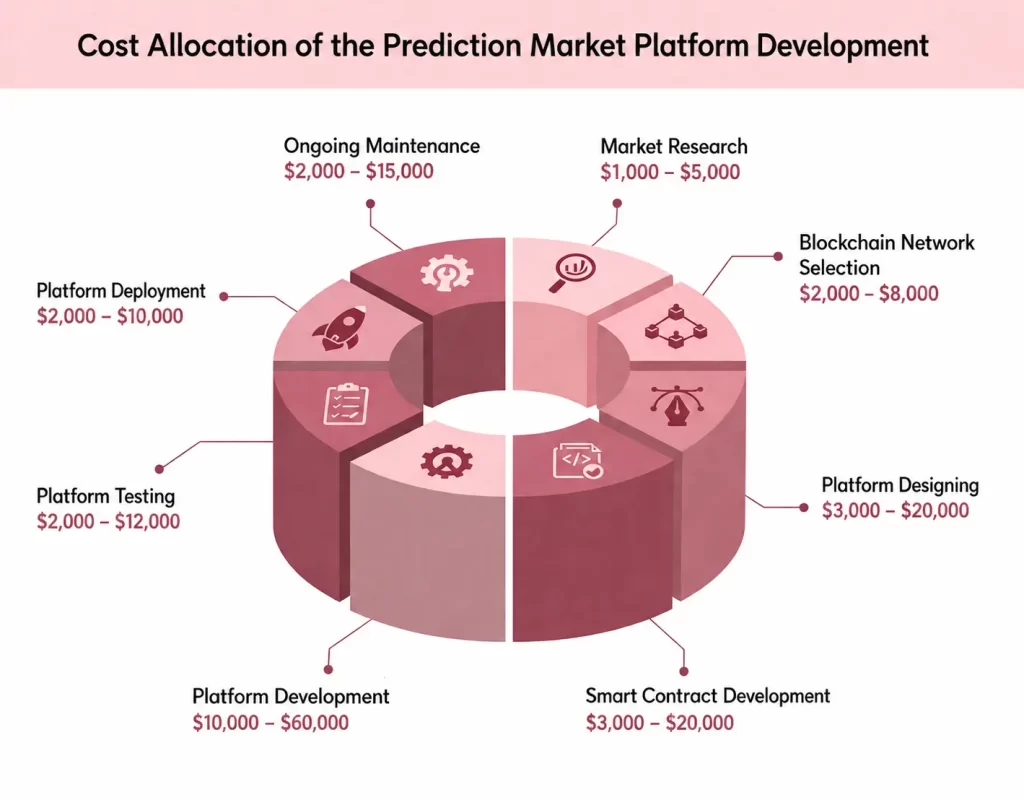
Individual factors shape the budget, but they do not set the total on their own. A realistic estimate considers every stage of development, because each phase adds to the final investment. The table below gives a phase-wise breakdown of the estimated timeline and cost.
| Phase | Estimated Timeline | Estimated Cost |
|---|---|---|
| Market Research | 1 to 2 Weeks | $1,000 to $5,000 |
| Blockchain Network Selection | 1 to 2 Weeks | $2,000 to $8,000 |
| Platform Designing | 3 to 4 Weeks | $3,000 to $20,000 |
| Smart Contract Development | 3 to 4 Weeks | $3,000 to $20,000 |
| Platform Development | 5 to 7 Weeks | $10,000 to $60,000 |
| Platform Testing | 1 to 2 Weeks | $2,000 to $12,000 |
| Platform Deployment | 2 to 4 Weeks | $2,000 to $10,000 |
| Ongoing Maintenance | Ongoing | $2,000 to $15,000 |
Phase 1: Conduct Market Research
Market research lays the foundation for a successful prediction market platform. This phase typically takes 3% to 5% of the development budget and covers the target audience, market niche, competitors, regulatory requirements, and business model.
Phase 2: Selecting the Right Blockchain Network
The right blockchain network supports scalability, security, and long-term performance. This phase generally takes 4% to 7% of the total project cost, as it involves evaluating blockchain ecosystems, transaction fees, integration requirements, and technical feasibility.
Phase 3: Platform Designing & Architecture
Platform architecture and UI/UX design define the user experience and the technical foundation. This stage usually takes 12% to 18% of the budget, covering wireframes, user flows, interface design, and system architecture.
Phase 4: Smart Contract Development
Smart contracts automate market creation, trade execution, fund management, and reward distribution. This phase typically takes 12% to 15% of the total investment, including contract development, testing, and security audits.
Phase 5: Platform Development
Platform development is the most resource-intensive stage. It generally takes 30% to 40% of the budget, covering frontend and backend development, core trading functions, APIs, wallet integration, databases, and other essential modules.
Phase 6: Platform Testing
Comprehensive testing makes sure the platform performs reliably under real-world conditions. This phase usually takes 6% to 10% of the budget and includes functional testing, security assessments, performance optimization, and bug fixing.
Phase 7: Platform Deployment
After testing, the team deploys the platform to production with proper infrastructure and security settings. Deployment generally takes 5% to 8% of the project cost, including CI/CD setup, cloud deployment, and mainnet configuration.
Phase 8: Ongoing Maintenance
Post-launch maintenance keeps the platform secure, scalable, and up to date. Allocate about 8% to 12% of the project budget each year for updates, feature enhancements, performance optimization, and technical support.
Want a Clear Cost for Your Prediction Platform?
Every prediction market platform comes with different cost factors. Share your requirements and get a tailored estimate based on your features, scalability goals, and business model.
Hidden Costs to Launch a Prediction Market Platform Successfully
The hidden expenses in launching a prediction market platform alone can add up to $30,000 or more.
Besides the estimated cost to create a prediction market platform, several other items add to your total. Plan for these hidden expenses before you start.
Here are the hidden costs that can significantly affect the overall cost of developing a prediction market platform.
| Hidden Component | Estimated Cost |
|---|---|
| Oracle Service Fees | $500 to $5,000 per month |
| Liquidity Bootstrapping | $15,000+ |
| Platform Upgrades | $10,000+ per year |
| Third Party Integrations | $3,000 to $15,000 |
| Scaling & Infrastructure | $1,000 to $5,000 |
Oracle service fees: This is one of the most common hidden costs. Prediction market platforms rely on external data sources to fetch real-world outcomes and results, and these services charge based on the data you need.
Liquidity bootstrapping: A prediction market needs enough liquidity for trades to fill at fair prices. Platforms often inject funds, offer incentives, or reward market makers to get early markets moving, which creates an expense.
Platform upgrades: Regular updates improve performance, add features, fix bugs, and respond to changing user demands. These improvements need ongoing development resources.
Third-party integrations: Prediction market platforms depend on external services such as payment gateways, KYC providers, wallet providers, analytics tools, and APIs. These integrations add up over time.
Scaling costs: As users, transactions, and data processing grow, the infrastructure must expand. Higher server costs raise your operating expenses.
These hidden costs play a crucial role in the long-term success of the platform. Planning for them early lets you scale effectively. None of these costs are fixed, and they change with the factors below.
Region-Based Cost to Develop a Prediction Market Platform
The cost of developing a prediction market platform varies with the location of your development team. Developer hourly rates differ across regions based on expertise, demand, and cost of living. Here are typical hourly rates we see across the main development regions.
| Top Countries | Hourly Rate |
|---|---|
| Hong Kong | $60 to $120 |
| European Countries | $70 to $130 |
| India | $20 to $30 |
| Japan | $80 to $140 |
| North America | $80 to $200 |
| Australia | $50 to $90 |
| UAE & Middle Eastern Countries | $40 to $110 |
| Singapore | $70 to $130 |
Choosing a region means balancing cost, technical expertise, regulatory familiarity, and scalability. Some regions offer cost-effective development, while others bring deep domain expertise and advanced infrastructure. Choose a team that fits your budget and requirements and brings an innovative, compliant approach.
Regulatory & Licensing Costs to Start a Prediction Market Platform
Legal and regulatory costs range from several thousand dollars to far higher amounts, depending on the target jurisdiction, platform model, licensing requirements, and compliance obligations.
For planning purposes, some businesses allocate $15,000 to $30,000 or more for initial legal and compliance work, although actual costs vary by jurisdiction.
Here is a quick breakdown of the key regulatory and licensing expenses for a single-jurisdiction launch.
| Regulatory Phases | Estimated Cost |
|---|---|
| Licensing Costs | $4,000 to $12,000 |
| Legal Setup | $2,000 to $6,000 |
| Regular Legal Audits | $1,500 to $4,000 |
| Ongoing Regulatory Updates | $1,000 to $3,000 |
| Regional Access Licenses | $1,500 to $5,000 |
Regulated US markets sit in a different cost bracket. In the US, event contracts fall under the CFTC, and the CFTC fined Polymarket $1.4 million in January 2022 for offering event-based binary options without registering. Polymarket later paid $112 million in July 2025 to acquire QCEX, a CFTC-licensed exchange and clearinghouse, to serve US users again. Read our guide to prediction market regulations and compliance before you pick a launch market.
From obtaining licenses to keeping up with evolving legal frameworks, these costs keep your platform operating securely and legally across regions. Investing in compliance prevents legal complications and builds long-term trust with users and investors.
Want to launch Your Prediction Platform Globally Without Any Regulatory Hassles?
Join us to plan your platform launch strategically across regions. We’ll help you fit the development and compliance costs within your budget.
Marketing Costs After Launching a Prediction Market Platform
Depending on the scale of the launch and your user acquisition strategy, plan for roughly $39,000 to $70,000 for marketing and promotion.
You can split this marketing budget as follows.
| Marketing Activities | Estimated Cost | Purpose |
|---|---|---|
| Brand Building | $5,000 to $7,000 | To create a strong brand and identity |
| Landing Page Optimization | $3,000 to $6,000 | Convert visitors into users |
| Social Media Community | $5,000 to $10,000 | Build an active and engaging community with users |
| Paid Ads | $10,000 to $20,000 | Run targeted ad campaigns to acquire users quickly |
| Influencer Marketing | $8,000 to $12,000 | Collaborate with top crypto influencers to boost reach |
| PR & Media Outreach | $5,000 to $8,000 | Build authority and brand trust across media |
| Content Marketing | $3,000 to $7,000 | Use SEO and content strategies to drive organic traffic |
Launching a prediction market platform successfully takes visibility, traction, and user trust. A well-planned marketing strategy helps your platform reach the right audience and gain early adoption.
Is It Worth Investing in Prediction Market Platform Development?
The short answer is yes, for teams that plan for liquidity and compliance. With growing blockchain adoption and rising demand for forecasting platforms, prediction market platform development has become a promising opportunity for startups and enterprises alike. These platforms generate recurring revenue while building highly engaged user communities across many industries.
Here are the key reasons why a prediction market platform is worth considering:
-
High User Engagement: Prediction market platforms encourage active participation through real-time event forecasting, which lifts user retention, engagement, and community growth.
-
Multiple Revenue Opportunities: Businesses can earn recurring revenue through trading fees, market creation fees, premium features, advertising, and other monetization models.
-
Growing Market Potential: As the prediction market industry expands, early investment lets businesses establish a competitive presence in a fast-growing market.
-
Wide Industry Applications: Prediction market platforms work across sports, finance, politics, entertainment, healthcare, and many other industries, reaching diverse audiences.
-
Scalable Business Model: With the right technology and infrastructure, prediction market platforms scale smoothly and support long-term growth.
Prediction market platforms are more than a trend. The success of the top prediction market platforms shows how businesses use this model to build engaged communities and generate sustainable revenue. Kalshi's path, covered in our guide on how to build a prediction market platform like Kalshi, shows how a regulated venue can grow.
Did You Know!
DraftKings and FanDuel, the two largest US fantasy sports and betting brands, both launched prediction market apps in December 2025, routing trades to CFTC-regulated exchanges.
Why Choose Pixel Web Solutions for Prediction Market Platform Development?
With over 12 years of blockchain development experience, Pixel Web Solutions has helped businesses build secure, scalable, and high-performing Web3 platforms. Having delivered 560+ projects for 350+ clients across 65+ countries, our team understands the technical and business challenges in prediction market platform development. From platform architecture and smart contract development to wallet integration, security, and deployment, we provide end-to-end development services tailored to your business goals. Whether you need a white-label solution or a custom-built platform, we deliver reliable, future-ready solutions designed for long-term growth.
FAQ: Prediction Market Platform Development Cost
1. What is a prediction market platform?
A prediction market platform is a system where users buy and sell contracts on the outcome of events. Markets cover sports, politics, finance, and other real-world events. The platform aggregates these trades into real-time probabilities.
2. How long does it take to develop a prediction market platform?
Development takes approximately 8 to 24 weeks, depending on the platform's complexity and development approach. A basic MVP may take 8 to 12 weeks, while advanced platforms and custom-built solutions can take 12 to 24 weeks or longer.
3. Is building a prediction market platform profitable?
Yes, a prediction market platform can be profitable with the right business model and user engagement. Revenue comes from trading fees, market creation fees, premium features, and advertising. Long-term success depends on platform security, liquidity, and attracting an active user base.
4. How much does it cost to build a platform like Polymarket?
Building a platform like Polymarket typically costs between $25,000 and $150,000+, depending on the features, blockchain network, smart contracts, security, and level of customization. An MVP or white-label solution can significantly reduce the initial investment.
5. What is the most cost-effective way to launch a prediction market?
The most cost-effective approach is a focused platform from $7,000 or a white-label or MVP prediction market platform. This lets businesses validate their idea, attract early users, and scale gradually while keeping initial development costs low.
6. Which blockchain is cost-effective for Prediction Market Platform Development?
Networks such as Polygon, Base, and Arbitrum are popular for their low transaction fees, high scalability, and strong developer ecosystems. Polymarket, for example, settles on Polygon. The right blockchain depends on your business goals, target audience, and platform requirements.
7. Can I launch an MVP for a Prediction Market Platform first?
Yes. An MVP is an ideal way to test your business model with essential features before investing in a fully customized solution. It reduces initial costs, speeds up market entry, and lets you scale based on user feedback.
8. What is the cheapest prediction market platform development cost?
Pixel Web Solutions' prediction market platform development starts at $7,000 for a focused platform with binary markets, a single resolution model, and core trading. Adding on-chain settlement, dispute escalation, more market types, or multi-jurisdiction compliance moves the project into the $25,000 to $150,000+ range.
9. What is prediction market software, and can I buy it ready-made?
Prediction market software is the trading engine, market creation tools, settlement contracts, wallet layer, and admin console that run a prediction market. You can license a ready-made white-label or clone script and customize it, which is faster and cheaper than building every module from scratch.
10. What are the ongoing costs of running a prediction market platform?
Plan for maintenance of about 8% to 12% of the project budget each year, oracle fees of $500 to $5,000 per month, infrastructure that grows with users, and upgrades of $10,000 or more per year. Liquidity incentives and compliance work are recurring costs too.
11. Do I need a license to run a prediction market platform?
It depends on the jurisdiction and the markets you list. In the US, event contracts are regulated by the CFTC, so venues need CFTC registration or a licensed partner. Other countries treat prediction markets as gambling or financial products, so take legal advice before you launch.